

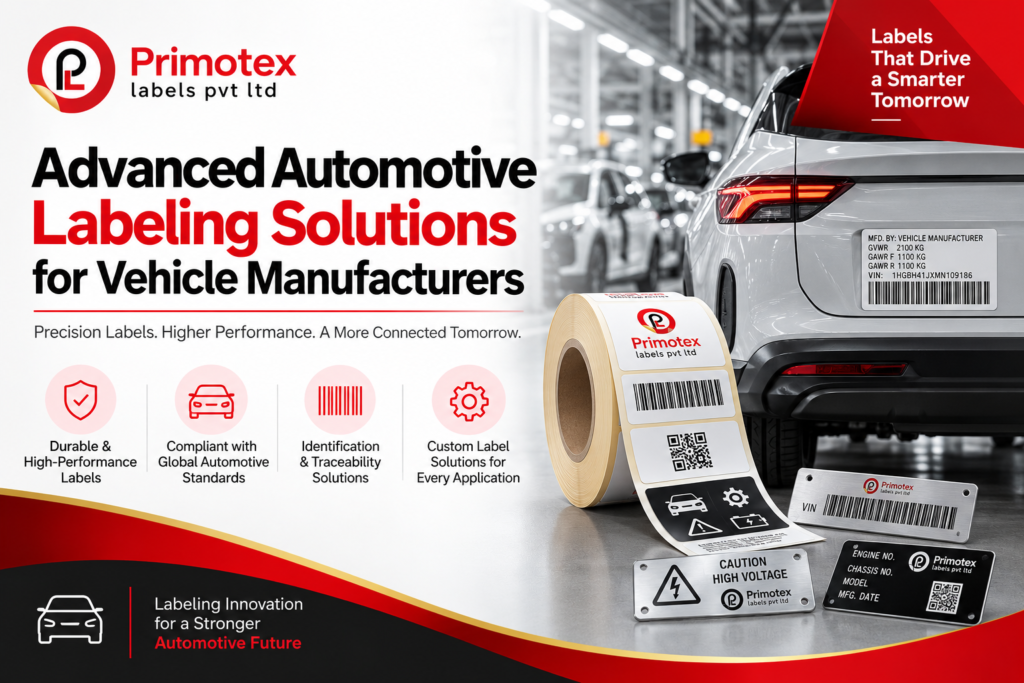
Modern vehicle manufacturing depends on much more than precision engineering and efficient assembly. Every vehicle and its individual components require accurate identification, traceability, safety information, and regulatory details throughout their lifecycle. This makes Automotive labeling solutions an essential part of modern manufacturing operations.
From VIN identification to under-hood information, battery identification, component tracking, and compliance requirements, manufacturers need labels that remain readable under demanding operating conditions. Reliable automotive labels help manufacturers maintain identification accuracy while supporting quality control, production efficiency, and regulatory compliance.
Why Automotive Labeling Matters in Vehicle Manufacturing
Automotive manufacturing involves thousands of individual parts moving through complex production and supply-chain processes. Without dependable identification, tracking the origin, specification, and movement of components can become difficult.
Effective automotive labeling provides manufacturers with a consistent method of identifying vehicles, assemblies, and individual parts. Labels can carry information such as serial numbers, barcodes, manufacturing data, specifications, warnings, and regulatory information.
For automotive OEMs and suppliers, this identification system supports several important activities:
- Vehicle and component identification
- Production and assembly tracking
- Product traceability
- Quality control
- Inventory management
- Regulatory identification
- Parts tracking across the supply chain
As manufacturing systems become more connected, traditional identification is also evolving toward smart labeling, serialized identification, and machine-readable codes.
Automotive Labels for Different Vehicle Applications
Different areas of a vehicle require different labeling characteristics. A label designed for an interior component may not withstand the heat, chemicals, abrasion, and moisture encountered in an engine compartment.
Common applications include VIN labels, VIN barcode labels, vehicle certification labels, compliance labels, warning labels, and safety labels. These provide critical information to manufacturers, service professionals, regulators, and vehicle owners.
Other applications include:
- Tire labels
- Under-hood labels
- Engine labels
- Battery labels
- Component identification labels
- Asset labels
- Serialized labels
- Barcode labels
- QR code labels
The right automotive label solutions therefore need to be selected according to the location, surface, environmental conditions, information requirements, and expected service life of the application.
Supporting Component Identification and Traceability
Modern vehicles contain a large number of automotive components sourced from multiple manufacturing facilities and suppliers. Maintaining accurate identification across these components is essential for efficient production.
Auto parts labeling enables manufacturers to assign clear identification to individual parts and assemblies. This can simplify parts identification during manufacturing, assembly, inspection, warehousing, and after-sales servicing.
For manufacturers working with Tier 1 suppliers, Tier 2 suppliers, and other partners, consistent identification can also improve component traceability. Serialized information can connect a component to its production batch, supplier, manufacturing date, or inspection record.
This approach helps manufacturers create a stronger chain of vehicle traceability and part traceability, particularly when products move through complex automotive supply chains.
Labels Built for Demanding Automotive Environments
Vehicles expose labels to conditions that ordinary commercial labels may not be designed to withstand. Heat, oils, solvents, sunlight, moisture, abrasion, and temperature fluctuations can gradually damage poorly selected materials or adhesives.
For demanding applications, durable automotive labels can be produced using materials and constructions suited to specific environmental requirements.
Depending on the application, manufacturers may require:
- High-temperature labels for heat-intensive areas
- Chemical-resistant labels for exposure to fluids and chemicals
- Abrasion-resistant labels for surfaces subject to friction
- Weather-resistant labels for exterior applications
- UV-resistant labels exposed to sunlight
- Heat-resistant labels for engine and powertrain areas
- Oil-resistant labels for areas exposed to automotive fluids
- Solvent-resistant labels for demanding industrial environments
- Moisture-resistant labels for humid or exposed locations
These characteristics contribute to long-lasting automotive labels that can retain critical information throughout the intended service period.
Materials and Printing Technologies
Material selection plays an important role in automotive identification. Depending on the application, manufacturers may use polyester automotive labels, polyimide labels, or other engineered materials.
Polyester constructions can provide durability for many general-purpose applications, while polyimide labels are often considered for applications involving elevated temperatures and demanding environmental conditions.
Printing technology also affects readability and durability. Thermal transfer labels are widely used where printed information needs to remain legible for extended periods. Industrial printing processes can support variable information such as serial numbers, barcodes, manufacturing codes, and production data.
For specialized requirements, industrial label printing can produce custom automotive labels in different sizes, formats, and specifications. Pressure-sensitive labels and adhesive labels can also be engineered around the substrate and operating environment.
Where permanent identification is required, permanent adhesive labels and high-performance adhesives can help maintain reliable attachment throughout the intended application lifecycle.
Compliance and Regulatory Identification
Automotive manufacturers must manage extensive identification and compliance requirements. Labels can communicate information required for vehicle certification, safety, handling, regulatory identification, and manufacturing processes.
Automotive labeling compliance is therefore not simply a printing consideration. The label must remain readable, securely attached, and appropriate for its intended environment.
Regulatory labels, compliance markings, safety information, and identification data need to be incorporated into the manufacturing process without compromising durability or readability.
Reliable labeling can support:
- Manufacturing compliance
- Industry compliance
- Regulatory identification
- Vehicle certification
- Safety communication
- Product traceability
- Serial number tracking
- Barcode traceability
For manufacturers, this creates a more controlled approach to documentation and identification across production operations.
Improving Production Efficiency with Automotive Labeling Systems
An effective automotive labeling system can become part of the wider production workflow rather than functioning as an isolated printing activity.
Production line labels can identify materials, assemblies, workstations, and completed units. Assembly line labeling can help operators and automated systems identify the correct components at different manufacturing stages.
Barcode and QR-based systems can also connect physical products with digital manufacturing records. This can support digital labeling, inventory management, quality checks, and serialized identification.
When properly integrated, labeling can reduce manual identification errors and make information easier to capture throughout vehicle manufacturing.
Choosing the Right Automotive Labeling Partner
Vehicle manufacturers should evaluate more than printing quality when selecting a labeling supplier. The supplier should understand the environmental and operational requirements associated with automotive applications.
Important considerations include:
- Application environment: Heat, chemicals, abrasion, UV exposure, moisture, and other conditions should be assessed before material selection.
- Substrate compatibility: The label and adhesive should work reliably with the surface on which they will be applied.
- Print durability: Variable information, barcodes, and other identification details should remain readable for the required lifecycle.
- Customization: Different vehicle components may require different sizes, materials, adhesives, and printing specifications.
- Traceability requirements: Serialized and machine-readable identification should be supported where required.
- Production scalability: Suppliers should be able to support both recurring production requirements and changing manufacturing volumes.
Primotex Labels: Automotive Labeling for Modern Manufacturers
For manufacturers looking for dependable labeling support, Primotex Labels Pvt Ltd provides customized labeling solutions designed around industrial and automotive requirements.
Its approach can support applications requiring durable materials, customized formats, high-quality printing, and reliable identification. From component identification and barcode applications to demanding under-hood and manufacturing environments, the focus is on developing labels around the actual operating conditions of the application.
For automotive OEMs, automotive suppliers, and manufacturers managing complex production environments, customized labeling can help establish a more consistent identification and traceability process.
The Future of Vehicle Labeling
Automotive manufacturing is moving toward greater automation, connectivity, and data-driven production. As this transition continues, vehicle identification labels will increasingly work alongside digital manufacturing systems rather than simply displaying static information.
QR codes, serialized data, barcodes, and connected identification systems can help bridge physical components with digital records. This can improve parts tracking, quality control, inventory visibility, and production efficiency.
The future of vehicle labeling will therefore depend on a combination of durable materials, reliable adhesives, machine-readable information, and integration with modern manufacturing workflows.
Conclusion
Reliable labeling is a small but critical part of the automotive manufacturing ecosystem. From VIN and certification information to component identification, safety communication, and traceability, labels help ensure that vehicles and their components remain identifiable throughout production and beyond.
Advanced Automotive labeling solutions give vehicle manufacturers the durability, customization, and identification capabilities needed for demanding applications. With the right materials, printing technology, adhesives, and traceability features, labeling can become an important contributor to manufacturing accuracy and operational efficiency.
With customized solutions from Primotex Labels Pvt Ltd, automotive manufacturers can address diverse labeling requirements while building a more reliable identification and traceability process across their production operations.