

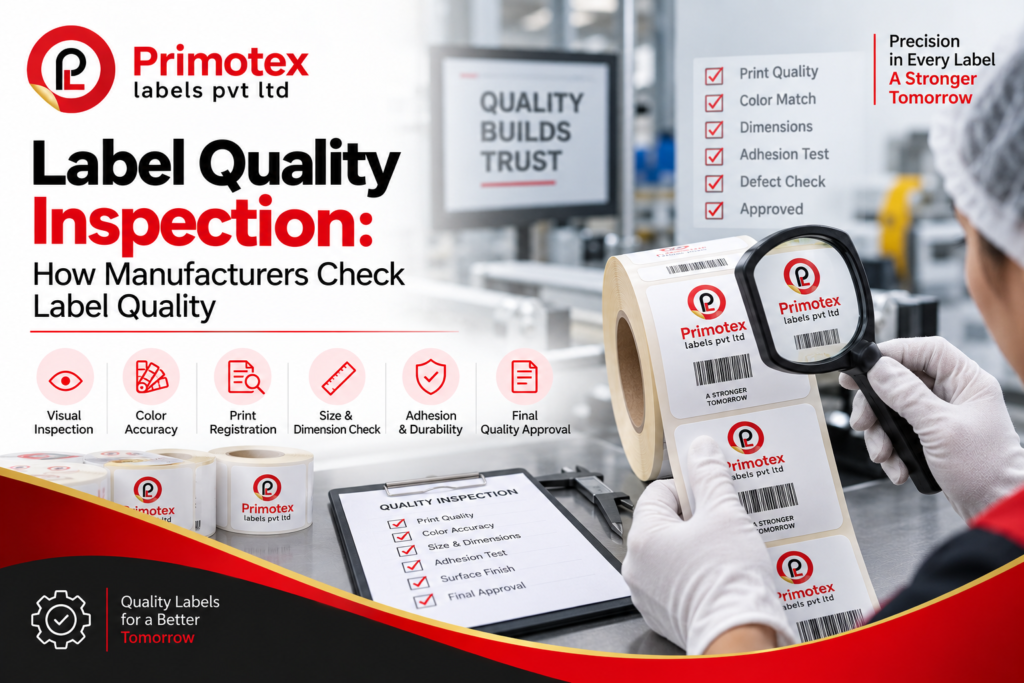
Labels do more than identify a product. They carry essential information such as product names, batch numbers, barcodes, expiry dates, safety instructions, and regulatory details. A printing error, weak adhesive, incorrect dimension, or unreadable barcode can affect product presentation, traceability, and compliance.
For this reason, manufacturers use a structured label quality inspection process throughout production. From raw-material checks to final inspection, every stage helps ensure that finished labels meet the required technical and visual specifications.
What Is Label Quality Control?
Label quality control is the systematic process of checking labels against predefined specifications. It covers appearance, printing, dimensions, material properties, adhesive performance, variable data, and regulatory requirements.
A proper label inspection process generally includes incoming material inspection, production-stage checks, sample testing, and final approval. Manufacturers establish inspection criteria and quality acceptance criteria before production so that defective products can be identified before shipment.
Effective label quality assurance also requires documented procedures, trained inspection personnel, calibrated equipment, and appropriate sampling plans.
Printing & Visual Quality Inspection
Printing is one of the first areas examined during print quality inspection. Manufacturers evaluate whether text, graphics, logos, colors, and other printed elements match the approved artwork.
During label print inspection, common parameters include:
- Print registration accuracy to ensure different colors and design elements align correctly.
- Color accuracy in labels and overall color consistency across production batches.
- Ink adhesion to determine whether printed areas remain firmly attached to the substrate.
- Print clarity and text readability for critical product information.
- Image resolution to ensure graphics and fine details remain sharp.
- Label color matching against approved color references.
Manufacturers also look for print defects, including smudging and bleeding, missing print, and misaligned printing. These issues can make a label appear unprofessional or, in applications such as pharmaceuticals and logistics, interfere with identification and traceability.
Barcode and Variable Data Verification
Barcodes and QR codes need more than visual approval. They must be machine-readable.
Barcode quality inspection can involve checking contrast, dimensions, quiet zones, print defects, and readability. A professional verifier can perform barcode grading to determine whether a code meets the required quality level.
Similarly, QR code verification confirms that the code can be reliably scanned.
Variable information requires additional controls. Manufacturers may use OCR inspection and OCV inspection to check printed characters, while production systems can verify:
- Serial number verification
- Batch number verification
- Lot number inspection
- Expiry date verification
- Variable print quality
These checks are particularly important where every label contains unique product information.
Material and Physical Quality
Printing quality alone does not determine whether a label is suitable for its application. Label material inspection examines the physical characteristics of the label stock and substrate.
A manufacturer’s label stock quality checks may include:
- Substrate quality
- Label thickness measurement
- Label dimensions
- Dimensional accuracy
- Surface condition
- Roll consistency
Depending on the intended application, label strength testing may also evaluate tear resistance, abrasion resistance, and scratch resistance.
Labels exposed to demanding environments may require moisture resistance, heat resistance, or chemical resistance testing. Durability testing helps determine whether the label will remain usable throughout transportation, storage, and product handling.
A label surface inspection can identify contamination, scratches, coating problems, or other defects that could affect printing or adhesion.
Adhesive Testing
For self-adhesive labels, adhesive performance is just as important as print quality. A label that looks perfect but separates from its intended surface is still a quality failure.
Adhesive quality testing may involve an adhesive strength test, peel strength testing, and evaluation of peel adhesion. Manufacturers may also perform tack testing to determine how quickly an adhesive bonds when pressure is applied.
Other evaluations can include shear resistance and general adhesive performance under different environmental conditions.
Different applications require different adhesive characteristics. Permanent adhesive testing helps validate labels intended for long-term bonding, while removable adhesive testing is used where clean removal is required.
Typical adhesive-related failures include adhesive failure, label lifting, and label edge lifting. Testing helps manufacturers identify these issues before products reach customers.
Common Label Defects Manufacturers Check
A structured label defects inspection program helps identify recurring production problems. Common issues include:
- Label wrinkles
- Label bubbles
- Label curling
- Label peeling
- Label misalignment
- Uneven cutting
- Die-cutting defects
- Poor print registration
- Color variation
- Ink smearing
- Barcode defects
- Damaged labels
- Inconsistent label size
The objective is not simply to reject defective labels. Manufacturers analyze why defects occur and improve the relevant production stage.
Manual and Automated Inspection Methods
Manufacturers may combine visual label inspection with automated technologies depending on production volume and application requirements.
Manual label inspection can be effective for sample-based checks and straightforward visual defects. However, high-volume production often benefits from automated label inspection, particularly where every label needs to be evaluated.
A camera-based inspection system or machine vision inspection solution can identify missing print, registration problems, incorrect graphics, and variable-data errors at production speed.
An automated label inspection machine may integrate multiple inspection functions, while optical inspection systems can detect fine visual differences that are difficult to identify consistently by eye.
Other tools include dimensional inspection, color measurement, and spectrophotometer testing. These technologies allow manufacturers to compare production output against defined specifications rather than relying solely on subjective visual judgment.
When Does Inspection Take Place?
Quality checks should not be limited to the final production stage.
Pre-production label inspection confirms that approved artwork, materials, colors, dimensions, and specifications are ready before manufacturing begins.
During production, in-process label inspection helps identify problems while they can still be corrected. Manufacturers may inspect printing, die cutting, finishing, and rewinding operations.
After production, post-production inspection and final label inspection verify whether finished goods meet the required standards.
For roll products, roll label inspection and label rewinding inspection can help identify damaged sections, splices, winding problems, and inconsistencies.
Sampling, AQL and Quality Standards
Not every manufacturing environment requires identical inspection intensity. A label sample inspection may use batch inspection, random sampling, and a defined quality sampling methodology.
Many quality systems use AQL (Acceptable Quality Limit) concepts to establish acceptable levels of defects within sampled production lots.
The applicable requirements also depend on the industry. Product labeling standards, regulatory labeling compliance, and customer specifications may determine the exact checks required.
For regulated applications, manufacturers may need to consider label compliance inspection, regulatory label requirements, GMP labeling requirements, and applicable ISO quality standards for labels.
Pharmaceutical manufacturers require particularly controlled processes for pharmaceutical label quality, while food, chemical, and industrial applications have their own requirements. Food label quality control may focus heavily on accurate product information, while chemical label inspection can involve safety and regulatory information.
Standards and systems such as ISO 9001, GS1, and GMP principles can support consistent quality management and traceability labels where applicable.
How Manufacturers Ensure Consistent Label Quality
A reliable manufacturing quality system connects inspection with corrective action. When a defect is discovered, manufacturers can investigate its cause, document the result, adjust production parameters, and verify that the correction has worked.
Label documentation may include inspection records, approved specifications, test results, and, where required, a certificate of analysis for labels.
For manufacturers and brands purchasing labels, working with an experienced supplier can simplify this process. Primotex Labels focuses on producing application-specific labels with attention to print quality, material selection, adhesive performance, dimensional consistency, and variable-data requirements.
For businesses requiring dependable printed labels, choosing a supplier with structured quality controls can reduce production issues and help maintain consistent output across repeated orders.
Label Quality Inspection Checklist
A practical label inspection checklist can include:
- Artwork and content accuracy
- Print registration
- Color consistency and matching
- Text and image clarity
- Barcode and QR code readability
- Variable-data accuracy
- Label dimensions and die-cut accuracy
- Material and thickness checks
- Adhesive and peel performance
- Resistance and durability requirements
- Surface defects
- Final packaging and roll condition
This approach helps manufacturers ensure label printing quality instead of relying only on final visual approval.
Final Thoughts
Reliable labels require more than attractive printing. Manufacturers need to control materials, dimensions, graphics, adhesives, barcodes, variable data, durability, and regulatory information throughout production.
A combination of manual checks, automated inspection, measurement equipment, sampling procedures, and documented quality systems creates a stronger label production quality control process.
For businesses looking for consistent and application-specific label solutions, Primotex Labels can support the process with professionally manufactured labels designed around product, industry, and performance requirements. The right quality-control approach ultimately helps manufacturers deliver labels that remain readable, durable, compliant, and fit for purpose.