

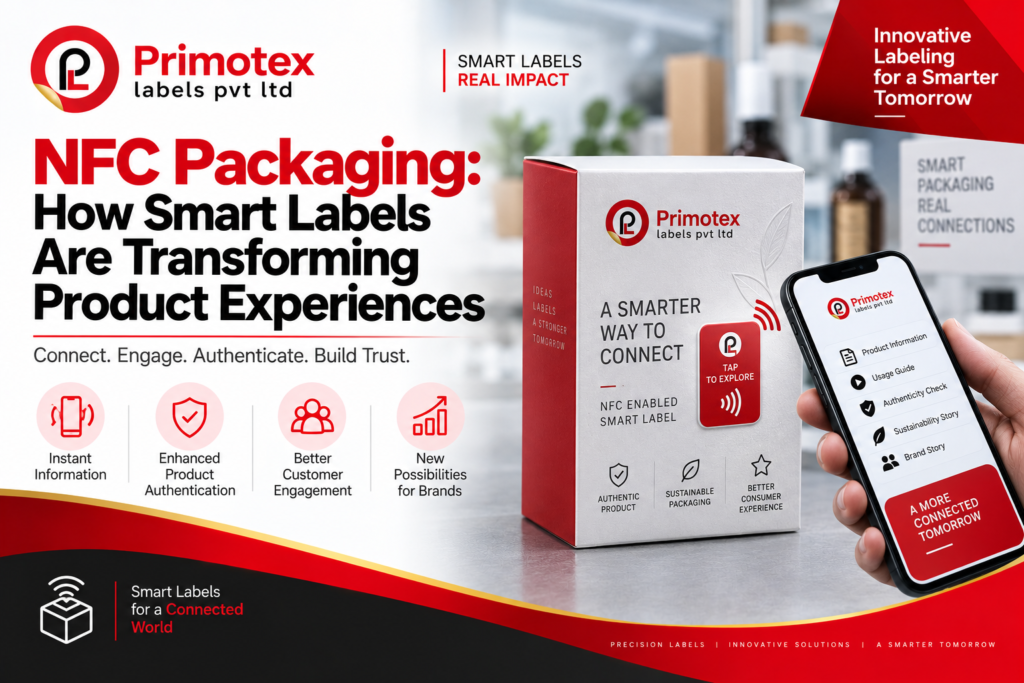
Packaging is no longer limited to protecting products or displaying brand information. With the integration of digital technology, packaging has become an interactive touchpoint that connects physical products with online experiences. NFC packaging is one of the innovations transforming how customers interact with brands, access product information, and verify authenticity.
NFC smart labels allow consumers to interact with packaging using compatible smartphones, often without scanning a QR code manually. From cosmetics and pharmaceuticals to luxury goods and food products, NFC-enabled packaging helps businesses create connected product experiences while supporting brand protection and product traceability.
For businesses exploring digital packaging solutions, understanding NFC technology, its applications, benefits, and manufacturing requirements can help them identify suitable opportunities. Companies such as Primotex Labels Private Limited can support the growing demand for customized packaging labels by offering expertise in label production and packaging solutions.
What Is NFC Packaging?
NFC packaging refers to packaging that incorporates Near Field Communication (NFC) technology to enable wireless interaction between a product and a compatible smartphone or NFC reader. The technology uses a small NFC chip and antenna, typically integrated into an NFC inlay, sticker, or label.
When a consumer brings an NFC-enabled smartphone close to the packaging, the embedded tag can trigger a predefined action, such as opening a website, displaying product details, or directing the user to an authentication platform.
Unlike traditional packaging, which primarily communicates through printed text and graphics, NFC-enabled packaging can provide a digital layer of information that brands can update or connect to online services.
How NFC Technology Works in Packaging
NFC is a short-range wireless technology designed for contactless communication between compatible devices. An NFC tag generally contains:
- NFC chip: Stores information or instructions.
- NFC antenna: Enables communication with a compatible device.
- NFC inlay: Integrates the chip and antenna into a form suitable for labels or packaging.
- Programming data: Contains information such as an NFC URL redirection address.
Many packaging applications use passive NFC tags, which do not require their own battery. When a compatible smartphone approaches the tag, the device can interact with the stored information.
The available features depend on the NFC chip, smartphone compatibility, tag programming, and the connected digital platform.
How NFC Smart Labels Transform Product Experiences
The growing adoption of smart packaging is changing how brands communicate with consumers. Instead of relying only on printed instructions, businesses can provide interactive product labels that connect physical packaging to digital content.
1. Interactive Product Information
NFC labels can provide quick access to product information, usage instructions, ingredient details, warranty information, or educational content. This helps brands make information accessible without overcrowding the physical packaging.
For example, a cosmetic brand can use an NFC-enabled sticker to direct customers to a product page containing application instructions, ingredient explanations, and related products.
This creates a digital product experience that extends beyond the initial purchase.
2. Product Authentication and Brand Protection
Counterfeit products create challenges for manufacturers, retailers, and consumers. NFC packaging can support authentication systems by connecting a product to a unique digital identifier.
An NFC product authentication system may direct users to an online verification page where product information can be checked. Depending on the implementation, brands can use secure NFC tags, unique identifiers, and backend verification processes to strengthen authenticity verification.
However, an NFC tag alone does not guarantee that a product is genuine. Effective anti-counterfeit packaging requires suitable security controls, tag configuration, and verification infrastructure.
For industries such as pharmaceuticals, luxury goods, and premium consumer products, digital authentication labels can form part of a broader brand protection strategy.
3. Improved Customer Engagement
Traditional packaging communicates information when a customer reads the label. Connected packaging can encourage further interaction through digital content.
Brands can use NFC technology in packaging to provide:
- Product tutorials and demonstrations
- Digital brand storytelling
- Promotional campaigns
- Customer feedback collection
- Product registration
- Loyalty program access
These features can support customer engagement through packaging by providing useful information before, during, and after purchase.
The effectiveness of such campaigns depends on the relevance of the content and how easily customers can access it.
NFC Packaging Applications Across Industries
NFC packaging has applications across several product categories. Its usefulness depends on the product’s characteristics, customer expectations, and the digital functionality required
NFC Packaging for Cosmetics and Consumer Goods
Cosmetic brands can integrate NFC labels for cosmetics to provide ingredient information, product tutorials, and authenticity verification. Smart packaging for FMCG products can also connect customers to brand campaigns, promotions, or digital product experiences.
For luxury products, NFC labels can help connect physical goods with digital authentication, ownership registration, and post-purchase services.
NFC Labels for Pharmaceutical Packaging
The pharmaceutical industry requires accurate product information, traceability, and packaging quality. NFC labels for pharmaceutical packaging can support access to digital instructions, product information, and verification services where the system is designed for the intended regulatory and operational requirements.
NFC technology should complement—not replace—mandatory printed information, regulatory labeling, or established pharmaceutical serialization and safety processes.
NFC Wine Bottle Labels and Food Packaging
NFC wine bottle labels can offer consumers information about a wine’s origin, production story, serving recommendations, and brand content.
Similarly, NFC food packaging can connect customers to information about ingredients, sourcing, preparation, and product education. The actual information provided depends on the brand’s digital platform and packaging implementation.
Key Benefits of NFC Smart Packaging
The integration of NFC technology offers several potential advantages for businesses and consumers.
| Benefit | How It Helps |
|---|---|
| Customer engagement | Provides interactive digital content |
| Product authentication | Supports digital verification workflows |
| Product transparency | Makes additional product information accessible |
| Brand differentiation | Creates a connected packaging experience |
| Product registration | Simplifies access to registration services |
| Customer feedback | Connects packaging to feedback forms |
| Product traceability | Can link products to digital records |
| Post-purchase engagement | Supports ongoing customer communication |
The value of NFC packaging depends on implementation. A tag that only opens a generic webpage may offer limited differentiation, while a well-designed digital experience can provide more relevant customer and business benefits.
NFC vs QR Code Packaging: Which Is Better?
NFC and QR codes are both used in smart packaging, but they operate differently. QR codes generally require a customer to open a smartphone camera or scanning application, while NFC tags communicate through proximity with a compatible device.
| Feature | NFC Packaging | QR Code Packaging |
|---|---|---|
| Interaction | Tap or bring a compatible device close | Scan a printed code |
| Hardware | NFC chip and antenna | Printed QR code |
| Visibility | May be integrated discreetly | Usually visible on packaging |
| User action | Device proximity | Camera-based scanning |
| Cost | Includes NFC component and integration | Generally inexpensive to print |
| Use cases | Authentication, tap experiences, registration | Information access, marketing, tracking links |
There is no universal solution for every packaging application. NFC vs QR code packaging decisions should consider the budget, required functionality, consumer behavior, durability, and authentication requirements.
Some brands may use both technologies. QR codes can provide broad access through visible scanning, while NFC can support convenient tap-based interaction and additional functionality.
NFC Packaging Manufacturing: What Brands Should Consider
The production of NFC packaging requires coordination between printed label design, material selection, tag integration, and quality control.
A smart label manufacturer may need to consider the following factors:
NFC Inlay Integration
NFC inlays must be selected according to the intended packaging format, operating environment, and required reading performance. Materials such as metal or certain liquids can affect NFC communication, making packaging testing important.
Printed NFC Labels and Customization
Printed NFC labels combine traditional label graphics with embedded digital functionality. Design considerations include label dimensions, adhesive compatibility, print quality, tag placement, and brand requirements.
Custom NFC labels may be developed for product packaging, bottles, cartons, containers, and other applications, depending on the production process and available materials.
Tag Programming and Quality Testing
NFC tag programming involves storing the required data, such as a URL or identifier, on the tag. Manufacturers and solution providers should verify tag functionality, readability, print quality, and adhesion before large-scale deployment.
For brands seeking NFC label manufacturing support, working with a label supplier that understands printing and packaging requirements can help coordinate physical label production with smart packaging integration.
Primotex Labels Private Limited: Supporting Advanced Packaging Labels
Primotex Labels Private Limited is a label manufacturing brand that can be positioned to serve businesses seeking customized, high-quality packaging and product labeling solutions.
As packaging evolves toward connected and interactive experiences, businesses need label partners who understand the importance of print quality, material selection, adhesive performance, and product-specific requirements.
For brands exploring NFC packaging labels, Primotex can be considered for discussions around customized label formats, printed packaging requirements, and potential smart label integration workflows. The availability of NFC inlay integration, tag programming, and other specialized capabilities should be confirmed directly with the company based on project specifications.
Whether the requirement involves consumer goods, pharmaceutical packaging, industrial products, or premium product labels, packaging design and manufacturing quality remain important considerations for a reliable product presentation.
Future of NFC Packaging and Connected Products
The future of NFC packaging is closely linked to the development of connected products, digital product records, and interactive brand experiences. As businesses explore new ways to engage consumers, packaging can become a gateway to product information, customer services, and digital authentication.
Potential developments include personalized product experiences, product lifecycle tracking, and smart supply chain packaging. However, adoption will depend on practical factors such as implementation costs, consumer participation, privacy considerations, and the value delivered through the connected experience.
NFC packaging is therefore not simply a replacement for traditional labels. It represents an opportunity to combine physical packaging with digital functionality in ways that support specific business and customer needs.
Frequently Asked Questions (FAQs)
1. What is NFC packaging used for?
NFC packaging is used for interactive product information, digital authentication, customer engagement, product registration, and selected traceability applications.
2. How do NFC smart labels work?
NFC smart labels contain an NFC chip and antenna. When a compatible smartphone interacts with the tag, it can open a digital experience such as a website or product information page.
3. Are NFC labels better than QR codes?
NFC and QR codes have different strengths. NFC supports proximity-based interactions, while QR codes can be scanned using a camera. The appropriate choice depends on the packaging requirements and budget.
4. Can NFC packaging help prevent counterfeit products?
NFC packaging can support product authentication and brand protection systems. However, effective counterfeit prevention requires appropriate security measures and verification infrastructure.
5. Can Primotex Labels Private Limited provide NFC labels?
Businesses should contact Primotex Labels Private Limited to confirm current NFC label manufacturing, NFC inlay integration, printing, and programming capabilities for their specific packaging requirements.
Conclusion
NFC packaging is transforming product experiences by connecting physical labels with digital information, authentication services, and customer engagement opportunities. From cosmetics and pharmaceuticals to food, beverages, and luxury products, NFC smart labels can support a range of packaging applications.
The success of NFC-enabled packaging depends on selecting the right technology, designing a useful digital experience, and ensuring reliable label manufacturing and integration.
For businesses exploring advanced packaging label solutions, Primotex Labels Private Limited can be approached to discuss customized label requirements and potential smart packaging applications