

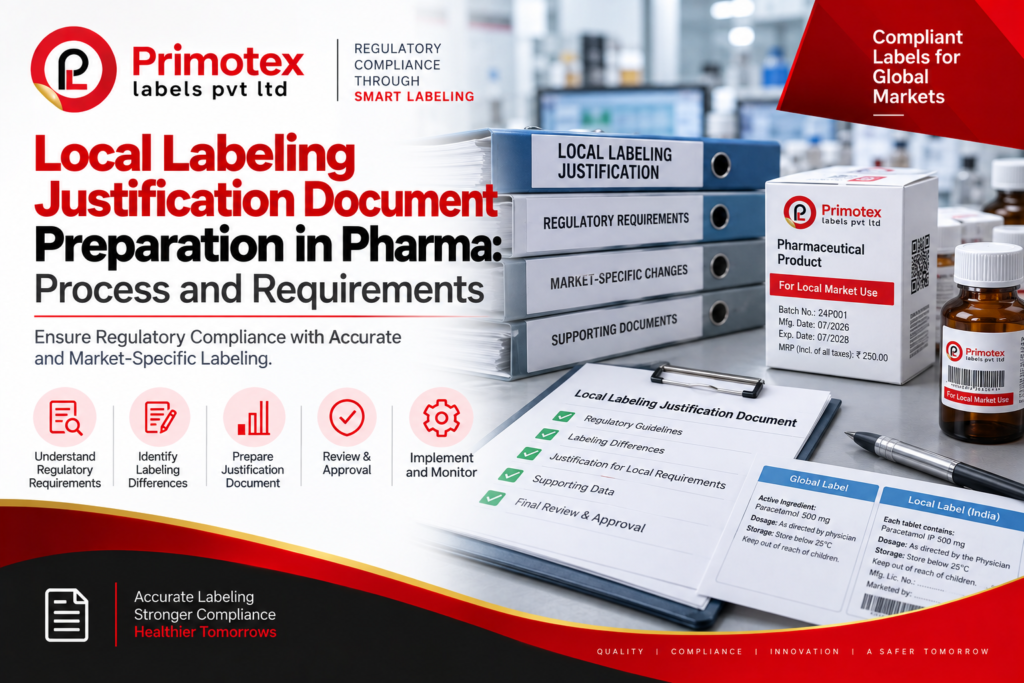
Pharmaceutical products are often developed and approved for multiple markets, but the same label cannot always be used in every country. Differences in regulatory requirements, language, product information, packaging formats, and health authority expectations can require companies to adapt global labeling for individual markets.
This is where a local labeling justification document becomes important. It provides a structured explanation of why specific differences exist between global labeling and the labeling required for a particular country or market.
For pharmaceutical manufacturers, marketing authorization holders, and regulatory affairs teams, proper pharmaceutical labeling justification helps create a documented rationale for local changes while supporting pharmaceutical label compliance.
What Is a Local Labeling Justification Document?
A local labeling justification document explains the differences between an approved global label or core labeling document and the version intended for a specific market.
The document normally connects three elements:
- The global or reference labeling
- The applicable local regulatory requirements
- The reason for each local labeling difference
A labeling justification rationale should therefore be evidence-based and traceable. It should explain whether a change was required because of a country-specific regulation, local language requirement, health authority expectation, product registration condition, or another documented regulatory consideration.
The exact requirements vary between jurisdictions. In India, for example, drug labeling and packaging are governed under the applicable Drugs and Cosmetics framework, while CDSCO guidance also identifies product labeling, primary and secondary package labels, and package inserts as relevant product information.
Why Is Local Labeling Justification Important in Pharma?
Pharmaceutical companies operating internationally frequently manage country-specific pharmaceutical labeling. A global label may contain information that is appropriate for one jurisdiction but require adaptation before the product can be marketed elsewhere.
A documented local labeling justification process provides a controlled way to record these differences.
It can help regulatory affairs teams:
- Explain local labeling differences
- Maintain regulatory labeling documentation
- Support label review and approval
- Connect label changes with applicable regulations
- Maintain consistency between approved information and artwork
- Provide evidence during regulatory or quality reviews
- Support controlled implementation of local artwork
Without proper documentation, a local adaptation can become difficult to trace later, particularly when multiple products, markets, strengths, and packaging configurations are involved.
Key Components of a Labeling Justification Document
A well-structured document should clearly identify what has changed and why.
1. Product and Market Information
The document can begin with basic product information such as:
- Product name
- Strength and dosage form
- Country or market
- Marketing authorization status
- Applicable regulatory authority
- Packaging configuration
- Reference labeling version
This establishes the scope of the regulatory justification document.
2. Reference Global Labeling
The next section should identify the global labeling source used for comparison. This may include the global core data sheet, product information document, approved prescribing information, package leaflet, or other controlled reference.
The objective is to establish a clear baseline before assessing local labeling requirements.
3. Identification of Local Differences
Each difference should be documented individually.
Examples may include:
- Additional mandatory statements
- Different product information
- Local language requirements
- Manufacturer or authorization-holder information
- Country-specific warnings
- Packaging declarations
- Local regulatory identifiers
- Differences in artwork presentation
This comparison creates a transparent record of justification for local labeling differences.
4. Regulatory Rationale
Every significant difference should have an appropriate rationale.
The rationale can reference the applicable regulation, health authority requirement, approved product information, or other controlled source.
For example, a company may need to explain that a particular statement was added because of a local regulatory requirement rather than because the global safety information itself changed.
This distinction is particularly important for regulatory labeling compliance.
Local Labeling Justification Process
A practical labeling justification process can be divided into several stages.
Step 1: Identify Applicable Regulations
The regulatory affairs team first determines the relevant country-specific regulatory requirements.
This may include regulations covering:
- Drug labeling
- Packaging
- Product information
- Language
- Safety statements
- Batch and expiry information
- Package inserts
- Artwork
- Local authorization details
Requirements should be checked against current official sources because regulations and regulatory guidance can change.
Step 2: Compare Global and Local Labeling
The global label is compared against the applicable local requirements.
This global-to-local labeling process helps identify what can remain unchanged and what needs adaptation.
A comparison matrix can be useful:
| Global Label | Local Requirement | Difference | Justification |
|---|---|---|---|
| Existing statement | Local requirement | Additional text | Regulatory requirement |
| Global language | Local language | Translation/adaptation | Local requirement |
| Global artwork | Country-specific artwork | Layout change | Local packaging requirement |
This approach makes the labeling assessment document easier to review.
Step 3: Document the Rationale
Each meaningful difference should have a concise explanation.
The rationale should answer:
What changed? Why did it change? Which requirement supports the change?
This creates a defensible label justification report instead of simply recording that an artwork modification was made.
Step 4: Regulatory and Quality Review
The completed documentation can then undergo regulatory label review, quality review, and appropriate approval according to the organization’s procedures.
The associated artwork may also require review before implementation.
Step 5: Implement Approved Artwork
Once approved, the final local artwork can be released through the organization’s established artwork management and change-control procedures.
This stage connects regulatory artwork approval with actual label production.
Pharmaceutical Labeling Components That May Require Localization
Local adaptation can affect several types of pharmaceutical labeling.
These may include:
- Primary packaging labeling
- Secondary packaging labeling
- Outer carton labeling
- Inner packaging labeling
- Bottle label requirements
- Blister pack labeling
- Package leaflet
- Patient information leaflet
- Prescribing information
- Summary of Product Characteristics (SmPC)
- Pharmaceutical artwork
- Regulatory artwork
Not every component will necessarily require the same level of localization. The applicable requirements depend on the country, product category, authorization, and packaging configuration.
For India, CDSCO documentation specifically refers to primary package labels, secondary package labels, and package inserts within product labeling information.
Common Challenges in Local Label Adaptation
The biggest challenge is not simply translating a label. Pharmaceutical labeling localization involves maintaining regulatory accuracy while adapting information for a specific market.
Common challenges include:
Maintaining Consistency
The local label should remain consistent with approved product information while incorporating legitimate country-specific requirements.
Managing Multiple Versions
Companies selling products in multiple markets may have numerous artwork versions. Strong pharmaceutical artwork management and version control therefore become essential.
Handling Regulatory Changes
Regulations and health authority expectations can change. CDSCO, for example, continues to publish amendments, notifications, and regulatory updates affecting the pharmaceutical sector.
Preventing Artwork Errors
A regulatory change can be correctly documented but incorrectly transferred into final artwork. This makes a controlled pharmaceutical artwork review and approval process important.
Local Labeling Compliance Checklist
Before final approval, regulatory teams can review whether the documentation covers:
- Product and market identification
- Applicable regulatory requirements
- Global reference labeling
- Local labeling differences
- Justification for each significant difference
- Supporting regulatory references
- Language requirements
- Packaging components
- Artwork version
- Review and approval history
- Change-control information
- Final implementation status
This local labeling justification checklist can help create consistency across products and markets.
How Primotex Labels Supports Pharmaceutical Label Printing
Once regulatory content has been finalized and approved, accurate printing becomes the next important step.
Primotex Labels Pvt Ltd provides Pharmaceutical label printing solutions for applications such as medicine bottles, vials, ampoules, cartons, blister packaging, and other pharmaceutical packaging requirements.
For pharmaceutical manufacturers, the objective is not simply to print text. Labels need to reproduce approved artwork accurately while supporting requirements such as readability, barcode printing, durability, adhesion, and variable product information.
Primotex Labels can support businesses requiring customized pharmaceutical labels for different packaging formats and market requirements. Its label manufacturing capabilities can be considered when a company needs to move from approved regulatory artwork to professionally printed pharmaceutical labels.
The regulatory approval itself remains the responsibility of the relevant pharmaceutical company and its regulatory processes; the printer’s role is to accurately manufacture the approved artwork.
Final Thoughts
A local labeling justification document provides a structured connection between global labeling and country-specific requirements. By identifying differences, documenting the regulatory rationale, reviewing artwork, and maintaining controlled implementation, pharmaceutical companies can make their local label adaptation process more traceable and manageable.
The strongest approach is to treat labeling as a lifecycle rather than a one-time artwork task. Regulatory requirements should be assessed, differences documented, artwork reviewed, approvals recorded, and approved versions controlled through implementation.
For pharmaceutical companies requiring professionally manufactured labels after regulatory approval, Primotex Labels Pvt Ltd can provide pharmaceutical label printing and customized label manufacturing support for different packaging applications.
Frequently Asked Questions
What is a local labeling justification document?
It is a document that explains the differences between global or reference labeling and the labeling used for a specific country or market, including the rationale and supporting regulatory basis for those differences.
What is the purpose of labeling justification?
The purpose is to create a documented rationale for local labeling differences and support traceability during regulatory review, artwork approval, and subsequent changes.
Does every country require the same pharmaceutical label?
No. Local product information requirements, language requirements, packaging rules, and regulatory expectations can vary by jurisdiction and product.
Who prepares pharmaceutical labeling documentation?
Depending on the organization, regulatory affairs, labeling, quality, medical, and artwork teams may contribute to the preparation and review of pharmaceutical labeling documentation.
What role does a label manufacturer play?
A label manufacturer produces the approved artwork according to the required specifications. Regulatory approval of the labeling remains with the pharmaceutical company and applicable regulatory authorities.
Can Primotex Labels manufacture pharmaceutical labels?
Yes. Primotex Labels Pvt Ltd provides pharmaceutical label printing and manufacturing solutions for different pharmaceutical packaging applications, including bottle, vial, ampoule, carton, and other label formats.