

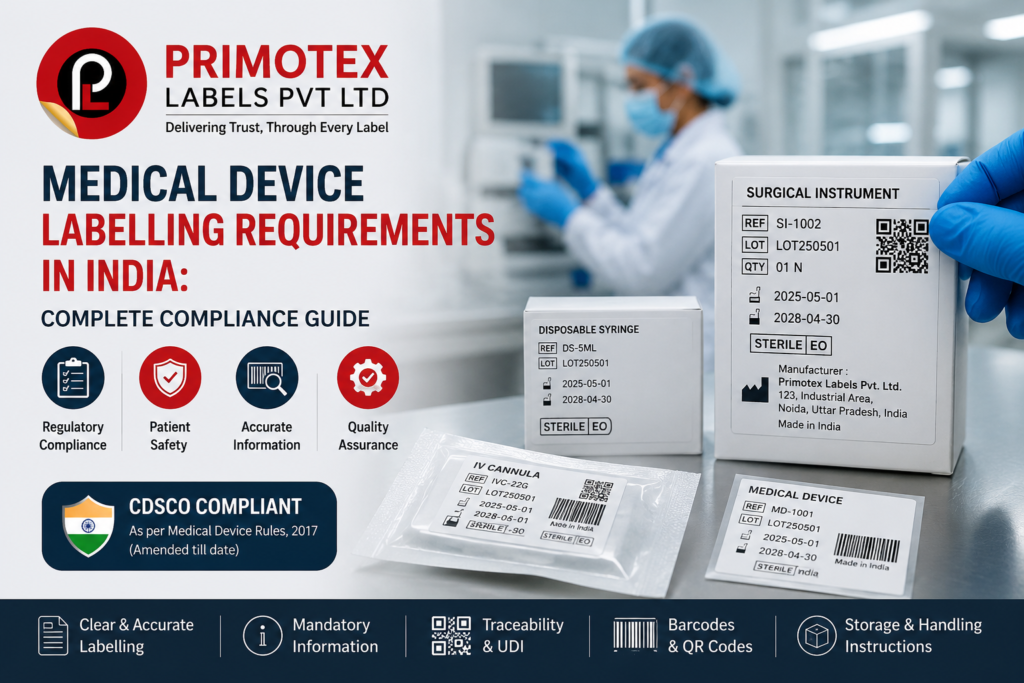
Medical device labelling is not simply a packaging exercise. In India, labels form part of the regulatory framework governing how a device is identified, used, stored, traced, and supplied to the market. Manufacturers and importers therefore need to align their medical device labelling requirements in India with the Medical Devices Rules, 2017 (MDR 2017) and applicable CDSCO requirements.
The Central Drugs Standard Control Organization (CDSCO), under the Ministry of Health & Family Welfare, regulates medical devices under the Drugs and Cosmetics Act, 1940 and the Medical Devices Rules, 2017. Medical devices are classified into Class A, B, C and D according to risk, and the applicable regulatory pathway can vary accordingly.
For manufacturers, choosing compliant medical device product labels, packaging materials and variable-data printing systems is therefore an important part of overall medical device regulatory compliance India.
What Are the Medical Device Labeling Requirements in India?
The principal requirements are contained in Chapter VI of the Medical Devices Rules, 2017, particularly Rule 44. The rule requires specified particulars to be printed in indelible ink on the label, shelf pack or outer cover and on every outer covering in which the device is packed.
The mandatory medical device label information generally includes:
| Label Information | Requirement |
|---|---|
| Device name | Name of the medical device |
| Identification | Details allowing the user to identify the device and its use |
| Manufacturer | Manufacturer name and manufacturing-premises address |
| Net quantity | Quantity expressed using the metric system |
| Manufacturing information | Month and year of manufacture |
| Expiry/shelf life | Month and year of expiry or applicable shelf-life information |
| Batch/lot | Distinctive batch or lot number |
| Storage | Special storage or handling conditions where applicable |
| Sterility | Sterile status and sterilisation method where applicable |
| Safety | Relevant warnings or precautions |
| Medicinal/biological content | Indication where applicable |
Rule 44 also contains specific provisions concerning expiry information, sterile devices, medicinal or biological substances, batch/lot identification, storage conditions and warnings.
Manufacturer and Device Identification
A compliant label should make the product readily identifiable. Depending on the device and its approved documentation, this can involve the device name, device description, model number, catalogue number, product identification code, intended use and other information necessary for safe identification and use.
The manufacturer’s name and address of the manufacturing premises are specifically addressed under Rule 44. This is important because a label should not be treated merely as a marketing surface; it carries regulatory identification information.
Packaging and Labeling Requirements for Medical Devices
Medical device packaging requirements India extend beyond the front product label. Rule 44 refers to the label, shelf pack or outer cover and every outer covering in which the device is packed.
Consequently, manufacturers may need to consider:
- Primary packaging
- Immediate containers
- Secondary packaging
- Outer packaging
- Medical device carton labeling
- Medical device box labeling
- Medical device pouch labeling
- Sterile barrier packaging
- Medical device sticker labels
For sterile products, the label must indicate the sterile state and sterilisation method where applicable. Storage and handling information should also be presented when special conditions apply.
This makes material selection equally important. Labels used on medical device packaging should remain readable and securely attached throughout the intended distribution and storage conditions.
Manufacturing Date, Expiry Date and Shelf Life
Manufacturing and expiry information is a major part of medical device labeling compliance.
Under Rule 44, the label generally carries the month and year of manufacture and expiry, or applicable shelf-life information. The rules provide exceptions for certain stable-material devices and certain equipment, instruments or apparatus. For sterile devices, the date of sterilisation may be used as the date of manufacture under the specified provision.
CDSCO’s FAQ also clarifies that the expiry date is expressed in terms of month and year.
Manufacturers should therefore control variable information carefully during production. Incorrect expiry dates, unreadable batch codes or mismatched manufacturing information can create significant product traceability and compliance problems.
Batch, Lot and Serial Number Traceability
Medical device traceability is closely connected with product identification.
Rule 44 requires a distinctive batch number or lot number, using prescribed wording such as “Lot No.”, “Batch No.” or equivalent permitted designation.
Depending on the product, manufacturers may additionally use:
- Batch number
- Lot number
- Serial number
- Model number
- Catalogue number
- Product code
- Manufacturing code
- Production identifier
Effective batch traceability helps manufacturers identify affected products during complaints, investigations, recalls and post-market surveillance.
UDI, Barcodes and Product Identification
The keyword medical device UDI requirements India requires particular care because the regulatory position has evolved.
Rule 46 was amended in 2021 to provide that, from a date specified by the Central Government, applicable medical devices approved for manufacture for sale or distribution or import would bear a unique device identification in the manner specified by the Government.
Therefore, UDI should not simply be treated as interchangeable with every barcode or QR code. A Unique Device Identifier (UDI) is a regulatory identification concept, while a GS1 barcode, GTIN, QR code medical device marking or other machine-readable code can be technologies used for identification and data capture depending on the applicable framework.
Manufacturers should verify the latest CDSCO notifications before finalising their UDI labeling, barcode labeling or product identification strategy.
Medical Device Labeling Symbols and Safety Information
Symbols can make packaging information easier to understand, particularly where space is limited or products are distributed across markets.
Common medical device labeling symbols may communicate information relating to:
- Sterile status
- Single use
- Batch or lot
- Expiry date
- Manufacturer
- Authorised representative
- Temperature limitations
- Keep dry
- Protect from sunlight
- Consult instructions for use
- Caution or warning
Standards such as ISO 15223-1 symbols may be relevant to graphical symbols used on medical device labels, but manufacturers should verify which standards and symbols are applicable to the particular device and regulatory submission.
The label should never rely on a symbol in a way that creates ambiguity about essential safety information.
Instructions for Use and Medical Device IFU
Labelling compliance does not end with the physical product label.
The Instructions for Use (IFU) may contain important information relating to:
- Intended purpose
- Intended user
- Operating instructions
- Safety instructions
- Warnings and precautions
- Contraindications
- Cleaning
- Sterilisation
- Maintenance
- Storage
- Handling
- Patient or healthcare-professional information
CDSCO’s FAQ confirms that medical devices offered for sale as single or multipacks should be accompanied by an IFU, prescribing information or relevant literature as applicable. CDSCO also recognises e-IFU under the MDR framework.
Requirements for Imported Medical Devices
Imported devices introduce additional considerations involving the foreign manufacturer, authorised agent India and Indian importer.
The applicable import framework is administered by the Central Licensing Authority for medical-device imports, while State Licensing Authorities have specified responsibilities for domestic manufacture of Class A and B devices and sale/distribution matters.
Imported-device labeling should therefore be reviewed against the approved regulatory documentation and applicable requirements before commercial distribution. Importers should pay particular attention to:
- Manufacturer identification
- Manufacturing-site information
- Importer/authorised-agent information where required
- Import licence information where applicable
- Product identification
- Batch/lot details
- Manufacturing and expiry information
- Storage conditions
- Safety information
- India-specific labeling requirements
CDSCO guidance also indicates that specimen original labels form part of relevant regulatory submissions for IVD imports, and India-specific labeling can be addressed under the Chapter VI requirements in circumstances recognised by the authority.
Medical Device Labeling Compliance Checklist
Before approving production artwork, a manufacturer can use the following medical device labeling compliance checklist India:
- Verify the device classification.
- Confirm the approved device name and intended purpose.
- Check manufacturer and manufacturing-site details.
- Verify applicable importer or authorised-agent information.
- Confirm manufacturing and expiry information.
- Verify batch, lot or serial identification.
- Check net quantity where applicable.
- Review storage and handling requirements.
- Confirm sterile status and sterilisation information where applicable.
- Review warnings, precautions and contraindications.
- Check applicable symbols and markings.
- Verify barcode, GTIN or other identification requirements.
- Cross-check the label against the approved technical documentation.
- Establish label revision and change control.
- Conduct a final regulatory label review before printing.
Why Label Quality Matters for Medical Device Manufacturers
Regulatory compliance and physical label performance are interconnected. A technically correct artwork can still create problems if the printed label becomes unreadable, detaches from packaging or fails to preserve variable data during storage and transportation.
This is where an experienced label manufacturer can add value.
Primotex Labels Pvt Ltd can support medical device manufacturers with professionally produced medical device product labels, packaging labels, barcode labels and customized adhesive labels designed around demanding identification and traceability applications. Its focus on label manufacturing makes it suitable for businesses requiring consistent printing, durable materials and controlled variable information for medical and healthcare products.
For manufacturers evaluating medical device packaging labels or customized sticker labels, Primotex Labels Pvt Ltd can be considered for label-production requirements where print quality, adhesion, durability and product identification are important.
Final Takeaway
The core of medical device labeling regulations India is not simply putting a product name on a sticker. The label must communicate the information required for identification, safe use, traceability, storage and regulatory control.
Rule 44 of the Medical Devices Rules, 2017 remains the central reference for general labeling requirements, while device classification, import/manufacturing status, IFU requirements, UDI developments and applicable standards can introduce additional considerations.
Manufacturers and importers should therefore treat labeling as part of their overall medical device regulatory compliance India, rather than as a final packaging activity.
Note: Regulatory requirements can change through CDSCO notifications and amendments. The latest CDSCO material should be checked before approving a commercial label or making a regulatory submission. CDSCO maintains the current Medical Devices Rules and related notifications on its official website.