

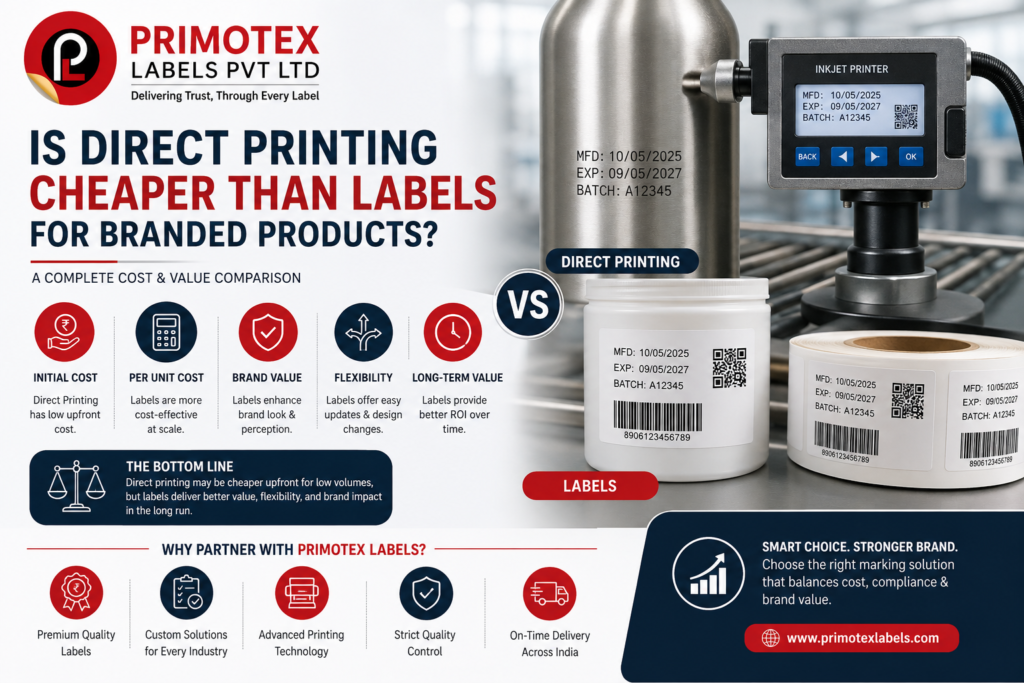
For manufacturers and brands, choosing between direct printing vs labels is not simply a question of which method has the lower printing price. The real comparison involves setup cost, material cost, application labor, production volume, durability, inventory, equipment, and the overall cost per product.
Both direct printing on products and adhesive labels can create professional branded packaging. However, the cheaper option depends heavily on the product, surface, order quantity, artwork changes, and production process.
For many businesses, custom printed labels remain a flexible and cost-effective solution, particularly when products are produced in multiple variations or in small and medium batches.
Direct Printing vs Labels: What Is the Difference?
Direct printing vs labeling involves two fundamentally different production approaches.
With direct printing, graphics, text, logos, barcodes, or other information are printed directly onto a product or its packaging. Common technologies include screen printing, pad printing, digital printing, inkjet printing, UV printing, flexographic printing, offset printing, thermal transfer printing, and laser marking.
Labels, on the other hand, are produced separately and then attached to the product. Adhesive labels, self-adhesive labels, and pressure-sensitive labels are widely used on bottles, boxes, containers, cartons, pouches, and industrial products.
This difference affects both the direct printing cost and the label printing cost.
Is Direct Printing Cheaper Than Adhesive Labels?
There is no universal answer. Direct printing can become economical at high production volumes because the cost of applying an individual label can be eliminated. However, direct printing normally requires dedicated equipment, artwork setup, surface preparation, and production integration.
Labels can involve an additional application step, especially when a label applicator or manual labeling labor is required. Yet the label itself can be manufactured in bulk at competitive rates, making the method attractive for many branded products.
A useful comparison therefore considers:
- printing cost per unit
- label cost per unit
- setup cost
- tooling cost
- material cost
- ink cost
- labor cost
- application cost
- equipment cost
- maintenance cost
- waste and spoilage
- production volume
- inventory requirements
The cheapest method is the one that produces the required result at the lowest total cost of ownership, not necessarily the lowest initial quotation.
Direct Printing Cost vs Product Label Cost

The product labeling cost of a label-based system generally consists of two main components: label production and label application.
A label manufacturer may produce roll labels using a printing press, followed by die-cutting, finishing, lamination, and quality inspection. The final cost per label depends on dimensions, material, colors, adhesive, finishing, quantity, and design complexity.
For direct printing, costs can include artwork setup, printing plates where applicable, tooling, ink, machine time, equipment depreciation, maintenance, and substrate preparation.
For very high-volume production, the printing cost per unit can fall significantly. In contrast, small production runs may make direct printing less economical because fixed setup costs are distributed across fewer products.
When Direct Printing Can Be More Cost-Effective
Direct printing becomes more attractive when production is consistent and volumes are high.
For example, a manufacturer producing millions of identical plastic containers may benefit from direct-to-surface printing because the branding process becomes part of the production line. There is no separate label stock to purchase, store, and apply.
Direct printing can also reduce:
- label inventory
- application labor
- excess label inventory
- storage requirements
- label handling
- some packaging production steps
Methods such as UV printing, screen printing, and inkjet printing can provide different combinations of speed, appearance, and durability.
However, the business must account for the equipment cost and maintenance cost. Purchasing or operating specialized printing machinery can make direct product printing expensive for smaller manufacturers.
When Labels Are the Cheaper Option
Labels often have a major advantage in flexibility.
A company can order custom product labels without investing in direct-printing equipment. The labels can then be applied manually or through automated equipment depending on production volume.
This is particularly useful for:
- small batch production
- seasonal products
- product variations
- frequent artwork changes
- promotional campaigns
- private-label products
- businesses testing new products
A manufacturer can also maintain different label designs while using the same basic packaging container.
For example, one bottle design can support multiple product variants simply by changing the bottle label. Changing the direct-printed artwork on the same container may require additional production preparation.
Direct Printing vs Labels for Branded Products
For branded product printing, appearance is only one part of the decision.
Direct printing can create a clean, integrated appearance because the design becomes part of the product surface. This can work particularly well for premium packaging, promotional products, containers, and products requiring permanent identification.
Labels provide greater design flexibility. Branded product labels can incorporate colors, logos, barcodes, variable information, product instructions, and decorative finishing.
Premium labels can also use lamination, specialty substrates, embossing, metallic effects, and other finishing techniques to improve packaging aesthetics, brand identity, and shelf appeal.
As a result, the better option depends on whether the priority is permanent decoration, flexibility, speed, cost, or premium presentation.
Durability: Labels vs Direct Printing
Durability can change the economics of a packaging decision.
Direct printing may provide strong print durability when the correct ink and curing system are selected. UV curing, for example, can improve ink performance on suitable surfaces.
Labels can also provide excellent label durability when the adhesive, substrate, ink, and protective finish are correctly matched.
Important performance factors include:
- scratch resistance
- water resistance
- chemical resistance
- UV resistance
- abrasion resistance
- fade resistance
- temperature resistance
- moisture resistance
- adhesive performance
- ink adhesion
- surface compatibility
For industrial products, automotive components, chemicals, or outdoor applications, durability should be evaluated before selecting either method.
Production Volume and MOQ Matter
MOQ, or minimum order quantity, is one of the most important factors in this comparison.
Direct printing may become increasingly economical as production moves from short-run printing to long-run printing and mass production. Fixed setup costs are spread across more units.
Labels can also benefit from volume pricing. A manufacturer ordering large quantities of roll labels may receive a substantially lower label cost per unit.
For low-volume production, however, labels often provide greater flexibility. A business can order smaller quantities instead of committing to large-scale printed packaging.
This makes labels particularly useful for small batch production and products with unpredictable demand.
Labels Reduce Packaging Inventory Risk
One overlooked advantage of labels is inventory management.
With printed packaging, every variation may require separate packaging stock. If artwork, regulatory information, pricing, or product specifications change, older packaging can become obsolete.
With labels, the base container can remain unchanged while the label design changes.
This can reduce the risk associated with:
- obsolete packaging
- excess inventory
- changing product information
- multiple SKUs
- seasonal branding
- frequent artwork revisions
For businesses managing numerous consumer products, this flexibility can have a meaningful impact on unit economics.
Direct Printing vs Labels: Quick Comparison
| Factor | Direct Printing | Adhesive Labels |
|---|---|---|
| Initial investment | Usually higher | Usually lower |
| Small batches | Less flexible | More flexible |
| High-volume production | Potentially economical | Also highly competitive |
| Artwork changes | Can be more complicated | Usually easier |
| Label inventory | Not required | Required |
| Application process | Integrated | Manual or automated |
| Equipment | Specialized equipment may be required | Label printer/manufacturer required |
| Customization | Moderate to high | Very high |
| Product variations | Less flexible | Highly flexible |
| Premium finishes | Depends on technology | Wide range available |
| Replacement | Requires reprinting | Label can often be replaced |
| Scalability | Strong for standardized production | Strong across different volumes |
Which Is Better: Direct Printing or Labels?
For most businesses, neither method is automatically better.
Direct printing can be the better choice when production volumes are consistently high, packaging designs remain stable, and integrating printing into the manufacturing process reduces application costs.
Labels are generally more attractive when flexibility, lower initial investment, product variations, short runs, and frequent design changes are important.
For many manufacturers, self-adhesive labels offer a practical balance between branding quality and production flexibility. They can be produced in different materials and sizes and supplied as roll labels for manual or automated application.
Why Custom Labels Can Be the Smarter Branding Solution
The cheapest product labeling method is not always the method with the lowest printing quotation. A complete comparison should consider equipment, labor, waste, inventory, maintenance, setup, production volume, and future design changes.
This is where a specialized custom label manufacturer can add value. A professional label printing company can help businesses select suitable substrates, adhesives, printing processes, finishes, and label formats according to product requirements.
For manufacturers looking for custom labels for businesses, Primotex Labels Pvt Ltd provides customized labeling solutions for a wide range of applications. Its capabilities can support product labels, industrial labels, packaging labels, barcode labels, and other customized requirements where branding, identification, durability, and consistent print quality are important.
The company can be considered by manufacturers seeking a product label manufacturer or printed label manufacturer for different production requirements.
Final Verdict
So, is direct printing cheaper than labels? Sometimes—but not automatically.
Direct printing can deliver a lower cost per product when production volumes are very high and the same design is printed continuously. Labels can be more economical when businesses need flexibility, multiple SKUs, smaller quantities, frequent artwork changes, or lower upfront investment.
The most reliable decision comes from comparing the complete product packaging costs, including setup, material, ink, labor, application, equipment, maintenance, waste, inventory, and production volume.
For many branded products, custom adhesive labels remain a practical and scalable solution because they combine affordable product branding with design flexibility, easier product variation, and manageable production costs. The right choice ultimately depends on the product surface, packaging format, production volume, durability requirements, and long-term unit economics.