

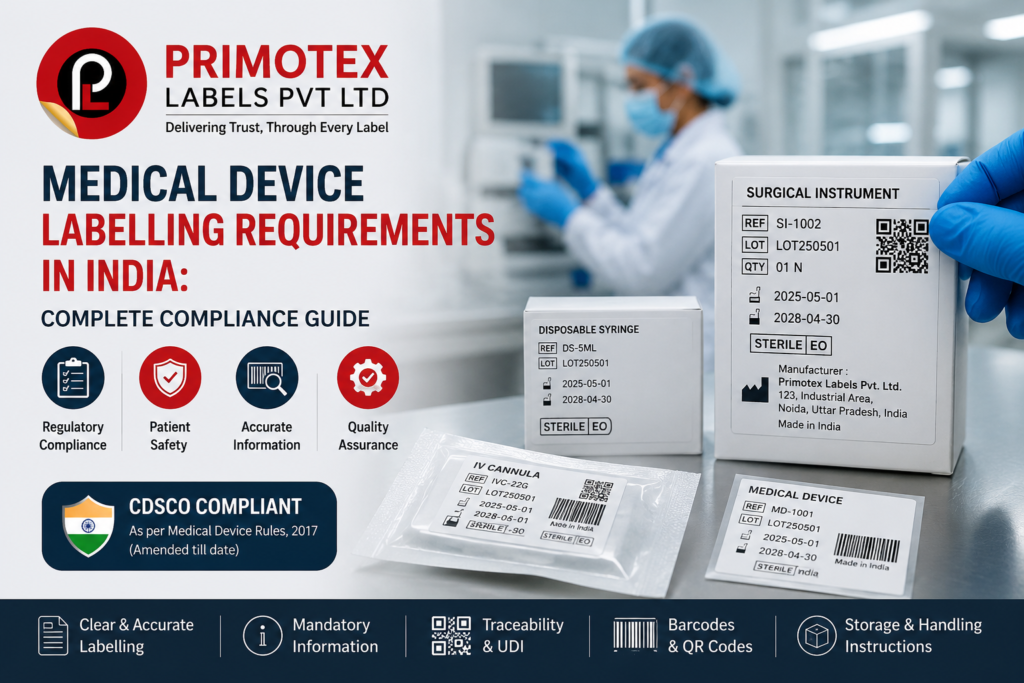
Clinical trials depend on accurate identification, traceability, and regulatory compliance at every stage of drug development. From investigational medicinal products and clinical trial supplies to biological samples and temperature-sensitive materials, every item needs clear and reliable identification. This is where Clinical Labeling Solutions become an essential part of clinical research and pharmaceutical operations.
For pharmaceutical and biotechnology companies, professional Clinical Labeling Services help ensure that clinical trial materials carry the right information while meeting applicable regulatory and quality requirements. Primotex Labels Pvt Ltd supports pharmaceutical, biotech, and research organizations with customized labeling solutions designed for demanding clinical environments.
What Are Clinical Labeling Solutions?
Clinical labeling refers to the design, production, printing, verification, and management of labels used for clinical research and pharmaceutical products. These labels may identify investigational products, clinical trial materials, biological samples, packaging components, and patient-specific supplies.
A reliable labeling system can include:
- Clinical Trial Labels
- Clinical Trial Labeling Services
- Pharmaceutical Clinical Labels
- Biotech Product Labels
- Drug Labeling Services
- Clinical Research Labeling
- Investigational Product Labeling
- Investigational Medicinal Product Labels
- IMP Labeling Services
- Clinical Trial Supply Labeling
The objective is not simply to print information. Clinical labels need to support product identification, patient safety, traceability, storage requirements, and regulatory compliance throughout the Clinical Supply Chain.
Clinical Trial Labeling for Pharmaceutical and Biotech Companies
Pharmaceutical and biotechnology companies operate under strict requirements where even a small labeling error can create operational or compliance challenges. Clinical Trial Labeling and Packaging therefore require careful coordination between clinical development, regulatory, manufacturing, packaging, and supply teams.
Clinical trial materials may include investigational drugs, placebo products, comparator products, research samples, and other clinical trial supplies. Labels may need to communicate batch or lot information, expiry dates, dosage details, administration instructions, storage conditions, and handling requirements.
Professional Clinical Supply Labeling helps organizations maintain consistency across different stages of the clinical trial process.
For pharmaceutical companies, this can involve:
- Investigational Drug Labeling
- Clinical Trial Drug Labels
- Clinical Trial Drug Packaging
- Pharmaceutical Packaging Labels
- Primary Packaging Labels
- Secondary Packaging Labels
- Vial Labels
- Bottle Labels
- Syringe Labels
- Ampoule Labels
- Carton Labels
- Blister Pack Labels
Biotechnology companies may require additional solutions for biologics, vaccines, cell therapies, gene therapies, and biological research materials.
Regulatory-Compliant Clinical Labels
Regulatory requirements are one of the most important considerations in clinical labeling. Clinical labels need to support applicable pharmaceutical and clinical trial requirements while maintaining accurate product identification.
Regulatory Compliant Labeling can incorporate requirements associated with FDA, EMA, ICH, GMP, GDP, and broader GxP quality systems, depending on the product, market, and clinical trial.
Important considerations can include:
- Clinical Labeling Compliance
- Pharmaceutical Label Compliance
- Clinical Trial Compliance
- Regulatory Labeling
- GxP Compliant Labeling
- GMP Compliant Labels
- GDP Compliant Labeling
- FDA Labeling Requirements
- EMA Labeling Requirements
- Drug Labeling Compliance
- Global Labeling Compliance
Since regulatory requirements may differ between countries, pharmaceutical organizations may also require Country-Specific Clinical Labels and multilingual labeling for international studies.
Identification and Traceability in Clinical Research
Clinical research involves numerous products and materials moving between manufacturers, clinical trial sites, investigators, laboratories, and other stakeholders. Accurate identification helps maintain traceability across this network.
Depending on the application, labels may contain:
- Product Identification Labels
- Drug Identification Labels
- Patient-Specific Labels
- Protocol-Specific Labels
- Batch Identification Labels
- Lot Number Labels
- Expiry Date Labels
- Storage Condition Labels
- Dosage Information Labels
- Administration Labels
- Warning Labels
- Handling Instruction Labels
- Barcoded Clinical Labels
- Serialized Clinical Labels
- Variable Data Labels
- Track and Trace Labels
These features can help clinical research teams distinguish products, maintain records, and reduce the possibility of identification errors.
Clinical Packaging and Specialized Labeling
Clinical products often require specialized packaging because pharmaceutical and biotechnology materials can have demanding storage and handling conditions.
Clinical Packaging Solutions may involve conventional pharmaceutical containers as well as temperature-sensitive and cryogenic applications.
Common requirements include:
Temperature-Sensitive and Cryogenic Labels
Some biological materials and investigational products require controlled temperatures during storage and transportation. Cryogenic Labels, Temperature-Sensitive Labels, Cold Chain Labels, and Ultra-Low Temperature Labels can be designed for applications where standard labels may not perform adequately.
For research laboratories, Cryogenic Sample Labels, Biological Sample Labels, Research Sample Labels, and Specimen Labels can support identification of valuable materials under challenging storage conditions.
Durable Pharmaceutical Labels
Clinical products may encounter refrigeration, freezing, moisture, abrasion, transportation, and repeated handling. Durable Pharmaceutical Labels can therefore be important where label adhesion and readability need to remain reliable throughout the product lifecycle.
Clinical Label Artwork Management and Change Control
Clinical labeling is not limited to printing. Artwork preparation and controlled document management are equally important.
Clinical Label Artwork Management can include Clinical Label Design, label proofing, approval workflows, and Label Version Control. These processes help ensure that the correct approved artwork reaches production.
Organizations may also require Clinical Label Change Management when information, regulatory requirements, packaging configurations, or trial protocols change.
For global studies, Clinical Label Translation and Multilingual Clinical Labeling may also be required to support different markets and clinical trial locations.
Why Professional Clinical Label Printing Matters
The physical quality of a clinical label can be as important as the information printed on it. Poor adhesion, illegible variable data, unsuitable materials, or inadequate resistance to environmental conditions can compromise usability.
Professional Clinical Label Printing and Pharmaceutical Label Printing can help address these challenges through controlled production processes and application-specific materials.
Custom solutions may include Custom Pharmaceutical Labels, Custom Clinical Labels, and Pharmaceutical Packaging Labels developed according to the container, environment, regulatory requirements, and intended use.
Choosing a Clinical Labeling Partner
Pharmaceutical and biotech organizations should evaluate more than printing capacity when selecting a labeling partner. The supplier should understand clinical workflows, pharmaceutical packaging requirements, variable data, quality expectations, and the importance of traceability.
A suitable partner should be capable of supporting:
- Clinical Trial Label Management
- Clinical Trial Packaging Solutions
- Clinical Supply Chain Labeling
- Investigational Product Labels
- Pharmaceutical and Biotech Labeling
- Clinical Research Materials
- Clinical Trial Supplies
- Trial Material Management
- Clinical Supply Management
Primotex Labels Pvt Ltd provides customized label manufacturing solutions for pharmaceutical, biotechnology, healthcare, and research applications. Its capabilities can support organizations looking for clinical labeling solutions for pharmaceutical companies, clinical labeling solutions for biotech companies, and clinical trial packaging and labeling services.
Clinical Labeling for Modern Drug Development
As pharmaceutical research becomes increasingly complex, clinical labeling must support faster development cycles, global studies, specialized products, and strict compliance requirements. Investigational medicinal products, biologic product labels, vaccine labels, cell therapy labels, and gene therapy labels may all require different labeling approaches.
A reliable labeling strategy can connect product identification with clinical operations, regulatory compliance, packaging, and supply chain management.
For organizations managing international clinical programs, global clinical trial labeling services can provide a more coordinated approach to country-specific requirements, artwork control, multilingual content, and production.
Conclusion
Clinical labeling plays a critical role in the safe and organized movement of investigational products and research materials throughout clinical development. Accurate labels support identification, traceability, storage information, compliance, and efficient clinical supply operations.
From IMP labeling services and pharmaceutical clinical labels to cryogenic sample identification and global clinical trial labeling, the right solution depends on the product, packaging format, trial protocol, market, and regulatory environment.
Primotex Labels Pvt Ltd helps pharmaceutical and biotechnology organizations address these requirements with customized labeling and printing solutions designed for demanding applications. With the right combination of materials, printing technology, variable data, artwork control, and quality-focused production, clinical labels can become a dependable part of the wider clinical supply chain.