

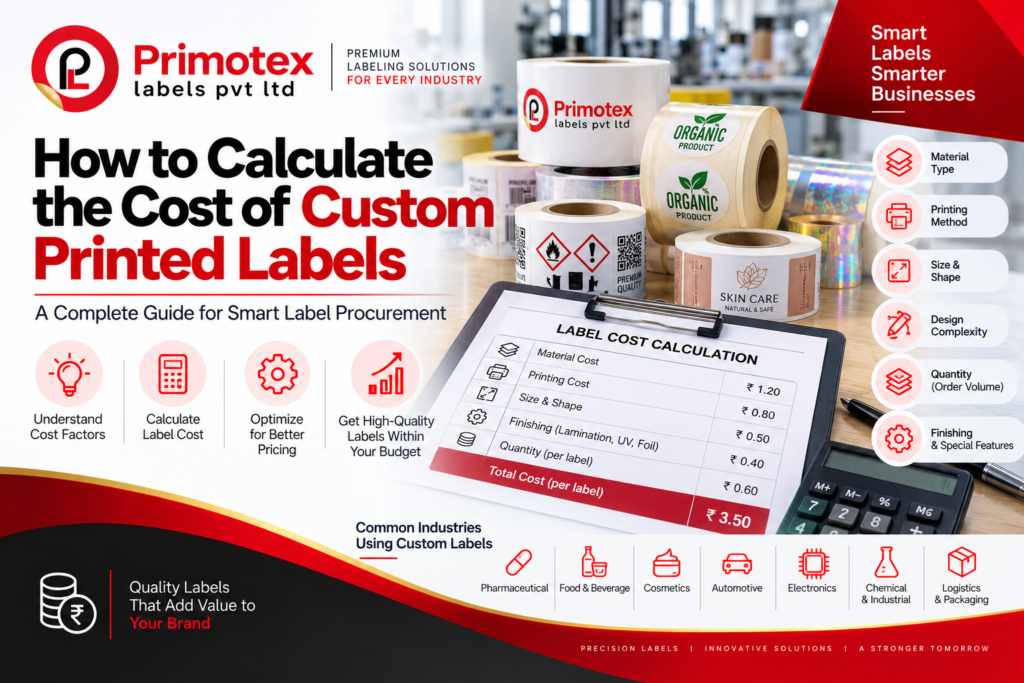
Custom printed labels play an important role in product packaging, branding, identification and compliance. From food and beverage products to cosmetics, pharmaceuticals, electronics and industrial equipment, businesses rely on high-quality labels to communicate essential information and create a consistent brand identity. However, the cost of custom printed labels can vary significantly depending on material selection, label dimensions, order quantity, printing technology and finishing requirements.
Understanding these factors helps businesses estimate their label printing budget, compare manufacturer quotations and choose suitable packaging solutions without compromising quality. This guide explains how to calculate the cost of custom printed labels and how businesses can make informed purchasing decisions.
What Factors Affect Custom Label Printing Cost?
The cost of custom label printing depends on several production variables. A clear understanding of these elements makes it easier to evaluate quotations and determine the actual cost per label.
1. Label Material
Material selection is one of the most important factors in label manufacturing cost. Different materials offer different levels of durability, appearance and resistance to environmental conditions.
Common options include:
- Paper labels: Suitable for many dry-product packaging applications and general-purpose labelling.
- BOPP labels: Commonly used where resistance to moisture and oils is important.
- Polyester and PET labels: Suitable for applications requiring durability and resistance to demanding conditions.
- Vinyl labels: Used for selected applications requiring flexibility and weather resistance.
- Transparent labels: Popular for cosmetic, personal care and premium packaging.
The appropriate material depends on the product surface, storage conditions, adhesive requirements and expected label lifespan. Choosing a material solely because it has a lower price can increase long-term costs if the label fails during use.
2. Label Size and Shape
Label dimensions directly influence material consumption. Larger labels generally require more material per unit, while custom shapes may require additional die-cutting or tooling.
For example, a 50 mm × 30 mm label covers 1,500 square millimetres. A 100 mm × 50 mm label covers 5,000 square millimetres. The second label uses more than three times the face area, although its final price will also depend on material layout, production efficiency and other specifications.
Standard shapes may be more economical to produce, while complex die-cut labels can require additional setup and processing.
3. Order Quantity and Minimum Order Quantity
The number of labels ordered affects the cost per piece. Many production expenses, such as artwork preparation, machine setup and tooling, are incurred regardless of the final quantity.
When these fixed costs are distributed across a larger production run, the setup cost per label generally decreases. This is why bulk label printing can provide a lower unit price.
However, larger orders require more upfront investment and storage space. Businesses should compare the savings against their expected demand, inventory capacity and risk of design changes.
4. Printing Method and Colour Requirements
The printing technology used for custom labels also influences the quotation.
Digital label printing offers flexibility for short production runs, multiple designs and variable information. It can be suitable for businesses testing new products or updating artwork frequently.
Flexographic printing is commonly used for higher-volume production. Its economics depend on factors such as printing plates, setup requirements, repeat orders and production quantity.
Offset printing may suit certain label applications requiring detailed, consistent printed output, depending on the equipment and material involved.
Colour count, ink coverage, artwork complexity and colour-matching requirements can also affect production costs. The most economical method depends on the complete job specification rather than the printing technology alone.
5. Adhesives and Finishing Options
Self-adhesive labels may require permanent, removable or specialised adhesives depending on the product surface and operating environment.
Additional finishing options can include matte or gloss lamination, spot UV, metallic foil stamping, embossing and protective coatings. These finishes can improve appearance, durability or brand presentation, but they may increase the total cost.
Businesses should select finishes according to their functional and branding requirements rather than adding decorative features that do not contribute to the product’s purpose.
How to Calculate the Cost Per Label
A practical way to estimate label printing cost is to combine the direct and indirect production expenses and divide the total by the number of usable labels produced.
Cost per label = Total production cost ÷ Total usable labels
The total production cost may include:
- Raw materials and adhesive
- Printing and machine setup
- Artwork preparation and printing plates, where applicable
- Die-cutting and tooling
- Finishing and quality inspection
- Labour and production overheads
- Packaging and delivery, if included in the quotation
Example of Custom Label Cost Calculation
Consider a hypothetical order of 10,000 custom printed labels with the following estimated expenses:
| Cost component | Illustrative cost |
|---|---|
| Label material | ₹4,000 |
| Printing and setup | ₹2,000 |
| Die-cutting and finishing | ₹1,000 |
| Labour and other production costs | ₹1,000 |
| Total production cost | ₹8,000 |
If all 10,000 labels are usable, the estimated cost per label is:
₹8,000 ÷ 10,000 = ₹0.80 per label
This example is for calculation purposes only and is not a market quotation from Primotex Labels. Actual pricing varies according to specifications, production conditions, applicable taxes and delivery requirements.
If the production process produces fewer usable labels because of wastage or defects, the cost per usable label increases. Businesses should therefore confirm whether the quoted quantity represents the total produced or the final acceptable quantity.
How to Reduce Custom Label Printing Costs
Businesses can manage their label printing budget through better planning without sacrificing necessary quality.
Optimise Label Dimensions
Selecting an efficient label size can reduce material consumption. Where appropriate, artwork and label layouts can be arranged to minimise unused space during production.
Order According to Actual Demand
Bulk orders may reduce the cost per unit, but excessive inventory can create storage expenses and waste when product designs change. Forecasting demand helps businesses balance volume discounts with inventory requirements.
Choose the Right Printing Technology
Short runs and frequent artwork changes may favour digital label printing, while repeat high-volume orders may benefit from flexographic production. A manufacturer can evaluate both options against the required quantity and specifications.
Review Finishing Requirements
Premium finishes can enhance packaging, but not every product requires foil stamping, embossing or specialised coatings. Choosing only the finishes that support the product’s appearance and performance can improve cost efficiency.
Approve Samples Before Production
Reviewing a label sample helps businesses verify dimensions, colours, readability, adhesive performance and material suitability before approving a large order. This can reduce the risk of expensive reprints and production delays.
How to Compare Label Manufacturer Quotations
The lowest quoted price does not always represent the best overall value. Quotations should be compared using identical specifications to avoid misleading price differences.
Businesses should check:
- Material type, thickness and adhesive specification
- Label dimensions and shape
- Printing method and colour requirements
- Finishing and die-cutting charges
- Minimum order quantity and price breaks
- Quality inspection and acceptable wastage
- Packaging, delivery timelines and additional charges
A transparent quotation should clearly explain what is included in the price. Businesses should also confirm whether taxes, freight, artwork preparation and tooling are charged separately.
Why Choose Primotex Labels for Custom Printed Labels?
Primotex Labels Pvt. Ltd. provides label solutions for businesses across industries that require product identification, packaging communication, branding and specialised labelling applications. Its website covers industry-specific label requirements, including automotive, electronics, pharmaceutical, cosmetic and food-related applications.
For businesses evaluating custom printed labels, material suitability, printing quality, consistency and production requirements are important considerations. Primotex can be approached to discuss the specifications of a proposed label order and obtain a quotation based on the actual application.
Before placing an order, buyers should share the label dimensions, preferred material, adhesive requirements, artwork, estimated quantity, finishing preferences and delivery expectations. Providing these details helps the manufacturer assess the requirements and prepare a more relevant quotation.
Conclusion
Calculating the cost of custom printed labels requires more than checking a price per piece. Material selection, label dimensions, production quantity, printing method, finishing, setup expenses and usable output all influence the final cost.
Businesses can make better purchasing decisions by comparing complete quotations, selecting materials suited to the application and planning order quantities carefully. Working with an experienced label manufacturer also helps clarify technical requirements before production begins.
Primotex Labels offers businesses a starting point for discussing custom label requirements across multiple industries. A detailed specification and quotation can help determine the most suitable solution for the product, budget and production needs.
Frequently Asked Questions
1. How much do custom printed labels cost?
The cost depends on material, dimensions, quantity, printing method, finishing and delivery requirements. A manufacturer can provide a more accurate quotation after reviewing the complete specifications.
2. Are bulk printed labels cheaper per piece?
Bulk orders often reduce the unit cost because setup expenses are spread across more labels. However, the best order quantity depends on demand, storage capacity and the likelihood of design changes.
3. Which material is best for custom labels?
Paper, BOPP, PET, polyester and vinyl serve different applications. The suitable option depends on the product surface, moisture exposure, durability requirements and intended use.
4. Does the printing method affect label pricing?
Yes. Digital, flexographic and offset printing have different setup requirements and production economics. The most suitable option depends on order volume, artwork complexity and the required finish.
5. What information is needed for a label printing quotation?
Businesses should provide label size, material, quantity, artwork, adhesive requirements, printing colours, finishing preferences and delivery location. These details help manufacturers prepare a more accurate estimate.