

OEM labels play an important role in product identification, branding, packaging, and traceability across industries. From automotive components and electronic appliances to pharmaceutical products and chemical containers, manufacturers rely on accurate, durable labels to communicate essential product information.
For businesses looking for reliable OEM label manufacturers in India, understanding the manufacturing process helps them make informed decisions about materials, printing methods, quality standards, and production costs.
Primotex Labels helps businesses meet their product identification and packaging needs with customised label solutions designed around their specific requirements. Choosing the right manufacturing partner can improve label consistency, support efficient production, and strengthen a product’s professional appearance.
What Is OEM Label Manufacturing?
OEM stands for Original Equipment Manufacturer. OEM label manufacturing involves producing labels according to a company’s product specifications, branding guidelines, and application requirements.
These labels can include product names, logos, model numbers, serial numbers, barcodes, QR codes, safety instructions, and regulatory information. Unlike generic labels, custom OEM labels are designed for particular products and operating conditions.
For example, an automotive manufacturer may require heat-resistant identification labels, while an electronics company may need compact labels that remain readable on equipment surfaces.
Businesses working with OEM label suppliers in India can request custom label dimensions, colours, materials, adhesives, and finishing options. These specifications help ensure that each label performs its intended function throughout the product’s lifecycle.
How OEM Label Manufacturing Works: Step-by-Step
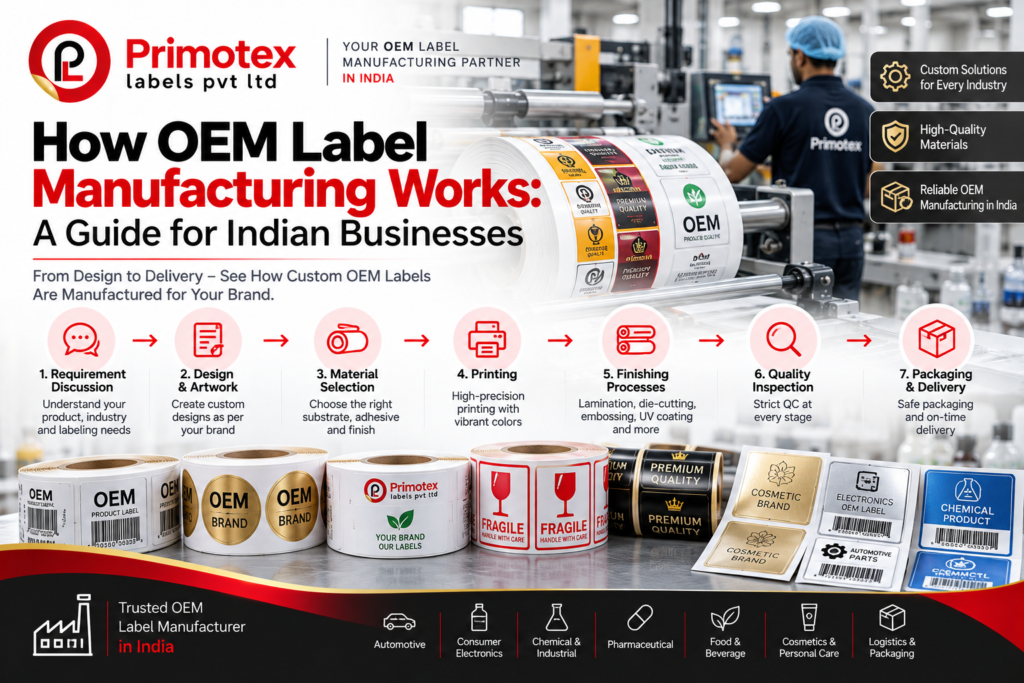
The OEM label manufacturing process involves several stages, from understanding product requirements to inspecting and delivering finished labels.
1. Understanding OEM Label Requirements
The process begins with identifying the product, its application, and the conditions in which the label will be used. Manufacturers assess factors such as surface type, temperature exposure, moisture, chemicals, abrasion, and expected product lifespan.
They also establish requirements for label dimensions, artwork, barcode readability, printing volume, and delivery schedules. Clear specifications help prevent errors during production and reduce unnecessary material waste.
2. Label Design and Artwork Approval
The next stage involves preparing the label design according to the customer’s branding and technical requirements. Product branding labels may include logos, product descriptions, warning symbols, serial numbers, and other identification details.
Artwork approval and proofing allow businesses to check colours, text placement, dimensions, and print clarity before bulk manufacturing begins. This stage is particularly important when OEM product labels contain technical information or machine-readable codes.
Approved artwork becomes the reference for maintaining consistency across production batches.
3. Choosing the Right Label Materials and Adhesives
Material selection directly affects label durability, appearance, and performance. Depending on the application, manufacturers may recommend paper, polyester, polypropylene, vinyl, or other suitable label materials.
Adhesive selection is equally important. Pressure-sensitive labels use adhesives that bond when pressure is applied, making them suitable for many product identification and packaging applications.
For demanding environments, waterproof product labels or chemical-resistant labels may be necessary. Automotive, machinery, and industrial applications may also require durable industrial labels that withstand heat, friction, or prolonged exposure to environmental conditions.
Primotex Labels can be considered for businesses seeking customised label solutions matched to their product specifications and operating requirements.
4. Selecting the Appropriate Printing Technology
The printing method depends on artwork complexity, production volume, material type, and budget.
- Digital label printing: Suitable for variable information, shorter runs, and designs requiring flexibility.
- Flexographic label printing: Commonly used for larger production volumes and consistent, repeatable printing.
- Specialised printing methods: May be appropriate for particular durability, appearance, or technical requirements.
During OEM label printing, manufacturers must maintain colour consistency, text clarity, and accurate reproduction of approved artwork. Barcode and QR code labels require particular attention because poor print quality can affect scanning performance.
5. Coating, Lamination, and Die-Cutting
After printing, labels may undergo additional finishing processes to improve their performance and appearance. Depending on the application, coating or lamination can provide added protection against moisture, scratches, and everyday wear.
Label finishing and die-cutting shape the labels to the required dimensions. Labels may be supplied in rolls or sheets according to the customer’s application and packaging equipment.
These finishing options help ensure that custom OEM labels fit the product correctly and can be applied efficiently during assembly or packaging.