

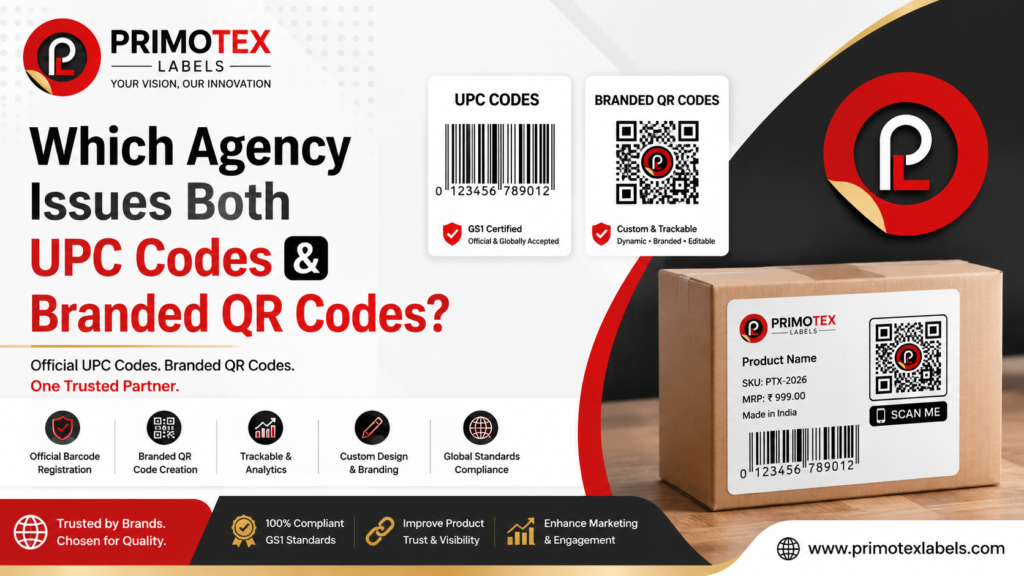
Businesses launching new products often ask the same question: which agency issues both UPC codes and branded QR codes? The answer is more nuanced than many people expect because these two technologies serve different purposes and are managed by different systems.
An Agency That Issues UPC Codes is responsible for assigning globally recognized product identifiers used in retail. A Branded QR Code Provider, on the other hand, creates customizable QR codes for marketing, customer engagement, product information, and digital experiences. While some companies offer both services under one platform, the official issuance of UPC codes follows international standards, whereas branded QR codes are generated through specialized QR platforms.
Understanding these differences helps businesses choose the right provider while maintaining compliance with retail requirements.
What Is a UPC Code?
A UPC (Universal Product Code) is a standardized barcode used to uniquely identify products sold in retail stores worldwide. Every barcode represents a specific product and enables fast scanning at checkout, inventory tracking, and supply chain automation.
An official UPC Code Agency assigns unique identifiers that become part of the global retail ecosystem.
A standard UPC includes:
- A unique company identifier
- Product reference number
- Check digit
- Machine-readable barcode
These identifiers support everything from Inventory Management to Retail Checkout, making them essential for modern commerce.
Who Issues Official UPC Codes?
The organization responsible for global barcode standards is GS1, a nonprofit Global Standards Organization.
National branches such as GS1 US, GS1 India, and GS1 UK issue official company prefixes and barcode numbers within their respective regions.
Businesses that register with GS1 receive a GS1 Company Prefix, allowing them to create multiple product identifiers while complying with worldwide Barcode Standards.
This process includes:
- UPC Registration
- Product Barcode Registration
- UPC Barcode Registration
- Barcode Registration Agency services
- Assignment of a UPC Number Provider account
These official registrations ensure products can be accepted by major retailers and marketplaces.
How to Get a UPC Code
For companies wondering How to Get a UPC Code, the process is straightforward.
- Register with the appropriate GS1 member organization.
- Obtain a company prefix.
- Assign a Global Trade Item Number (GTIN) to each product.
- Generate a barcode image.
- Print the barcode on Product Packaging.
Many businesses searching Where to Get UPC Codes or Who Issues UPC Codes eventually discover that purchasing directly from GS1 provides long-term ownership and credibility.
Although some resellers advertise Buy UPC Codes, businesses should understand the difference between licensed codes and official registrations before making a decision.
What Is a Branded QR Code?
Unlike retail barcodes, QR codes are designed to connect physical products with digital content.
A professional QR Code Provider creates customized codes that may include:
- Brand colors
- Company logos
- Landing pages
- Product manuals
- Promotional campaigns
- Customer support
Today’s businesses commonly use:
- Branded QR Codes
- Custom QR Codes
- Dynamic QR Codes
- Static QR Codes
- QR Code with Logo
These codes help improve customer interaction beyond the retail shelf.
What Can a Branded QR Code Do?
Modern QR platforms provide much more than simple links.
Advanced features often include:
- QR Code Branding
- Marketing QR Codes
- QR Code Management
- Editable QR Codes
- Trackable QR Codes
- QR Code Analytics
- Smart QR Codes
- Digital Product QR Codes
- QR Code Campaigns
- Custom Logo QR Codes
These capabilities make QR technology valuable for marketing teams, manufacturers, and ecommerce brands.
Can One Agency Provide Both UPC Codes and Branded QR Codes?
Yes—but with an important distinction.
Some companies combine services by offering official GS1 barcode registration alongside QR code creation within one platform.
In these cases, the provider acts as:
- A UPC Barcode Provider
- A Barcode Issuing Organization
- A Product Barcode Service
- A Barcode Supplier
- A branded QR code platform
However, official UPC ownership still originates from GS1 standards. QR codes, meanwhile, are created through the provider’s own software rather than being issued by GS1.
For businesses wanting a single workflow, choosing a platform that supports both barcode registration and QR management can simplify product onboarding.
UPC Codes vs QR Codes
Understanding UPC Codes vs QR Codes is essential before selecting a provider.
| UPC Codes | QR Codes |
|---|---|
| Identify products | Share digital information |
| Required for retail scanning | Used for customer engagement |
| Based on GTIN standards | No retail identifier required |
| Fixed product identity | Can link to changing content |
| Used by POS systems | Used by smartphones |
Both technologies complement each other rather than compete.
Barcode vs QR Code
Many businesses compare Barcode vs QR Code, but each serves a different purpose.
Traditional barcodes are optimized for fast scanning inside retail environments. QR codes store much more information and can direct customers to websites, videos, warranty pages, or product registration portals.
A product often benefits from using both.
GTIN vs UPC
Another common comparison is GTIN vs UPC.
A GTIN is the broader global numbering system used for product identification.
A UPC is one specific GTIN format primarily used in North America.
Every UPC belongs to the GTIN family, but not every GTIN is a UPC.
EAN vs UPC
International sellers frequently compare EAN vs UPC.
A UPC-A barcode contains 12 digits and is widely accepted across the United States and Canada.
An EAN Barcode, particularly EAN-13, is the standard format used in many other countries.
Businesses selling internationally should verify which barcode format is required for their target market.
Official UPC vs Reseller UPC
The debate between Official UPC vs Reseller UPC often comes down to long-term ownership.
Official GS1 registration offers:
- Greater retailer acceptance
- Better brand credibility
- Direct ownership
- Easier expansion
- Global compatibility
Reseller codes may work for some marketplaces but may not provide the same level of ownership or flexibility.
Barcode Registration vs QR Code Creation
Businesses should understand the distinction between Barcode Registration vs QR Code Creation.
Barcode registration creates a permanent retail identifier linked to a product.
QR code creation generates a scannable marketing asset that can direct users to digital experiences.
One supports retail infrastructure while the other supports customer engagement.
Product Barcode vs Marketing QR Code
A Product Barcode vs Marketing QR Code comparison highlights different business goals.
Product barcodes enable retail operations such as:
- POS System
- Warehouse Management
- Supply Chain Management
- SKU Management
Marketing QR codes focus on:
- Product education
- Promotions
- Customer loyalty
- Product authentication
- Interactive campaigns
Successful brands frequently place both codes on the same package.
QR Code Service vs GS1
Many people mistakenly compare QR Code Service vs GS1 as though they perform identical roles.
GS1 manages standardized product identification.
QR service providers focus on digital marketing, customization, analytics, and customer engagement.
Rather than replacing each other, the two systems work together.
Why Businesses Use Both Technologies
Modern manufacturers increasingly combine official barcodes with branded QR codes.
Benefits include:
- Better Product Labeling
- Faster retail acceptance
- Improved Product Catalog organization
- Easier Amazon Product Listings
- Better support for Walmart Marketplace
- Enhanced Consumer Goods tracking
- Stronger Product Authentication
- Accurate Barcode Verification
- Better ecommerce experiences
This combination supports both operational efficiency and customer communication.
Choosing the Right Provider
When evaluating providers, businesses should consider whether the company offers:
- Official Barcode Authority registration
- Reliable Barcode Licensing
- Proper Barcode Company Prefix assignment
- Accurate UPC Barcode Assignment
- Support for Retail Barcode Registration
- Access to the global Barcode Database
- Integration with a Product Data Registry
- Compatibility with the Global Barcode System
At the same time, businesses should evaluate QR capabilities such as branding, analytics, dynamic editing, and campaign management.
Final Thoughts
There is no single organization that officially issues both UPC codes and branded QR codes in the same way. GS1 remains the recognized authority for official UPC and GTIN assignment through regional organizations such as GS1 US, GS1 India, and GS1 UK. Branded QR codes, however, are created by specialized QR platforms.
Businesses looking for convenience can choose service providers that combine official barcode registration assistance with professional QR code generation under one solution. This approach allows companies to meet retail requirements while also delivering engaging digital experiences for customers.
When both technologies are implemented correctly, products gain stronger retail compatibility, better inventory control, richer customer interactions, and improved long-term brand value.