

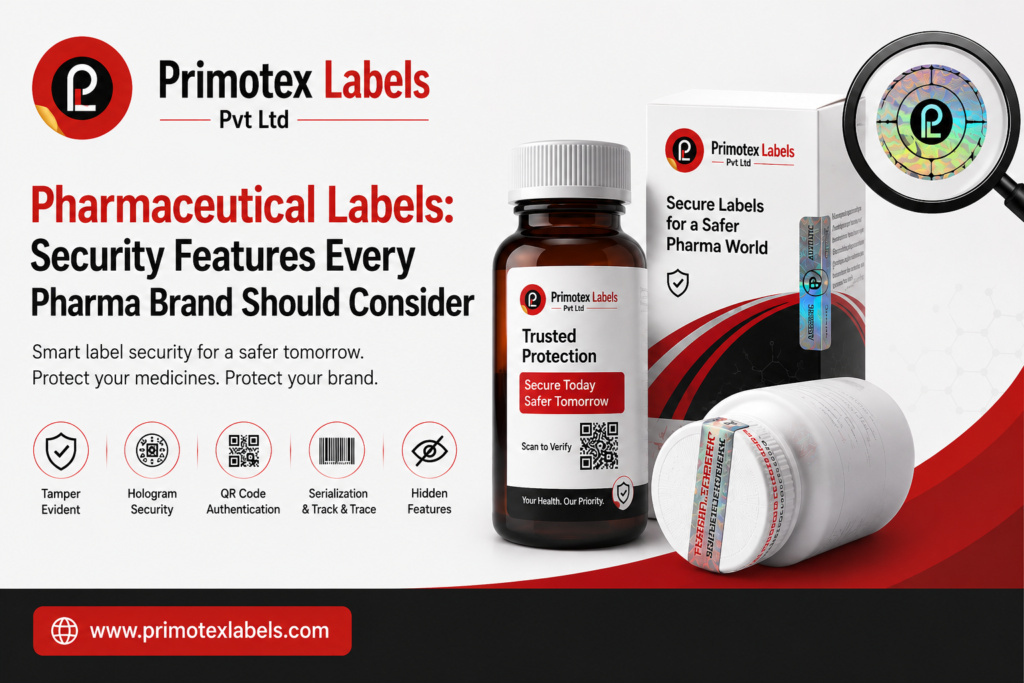
The pharmaceutical industry faces a serious challenge from counterfeit medicines, supply chain gaps, and product tampering. For pharma brands, packaging is no longer just about displaying product information. Pharmaceutical labels now play an important role in product protection, authentication, traceability, compliance, and patient safety.
A well-designed pharma label can help manufacturers identify products, track their movement, prevent unauthorized duplication, and provide visible evidence if packaging has been opened or altered. From holograms and tamper-evident seals to QR codes and serialization, modern pharmaceutical packaging labels can combine multiple layers of protection.
This article explores the most important security features every pharmaceutical brand should consider when developing secure drug packaging and improving pharmaceutical brand protection.
Why Pharmaceutical Label Security Matters
The consequences of pharmaceutical counterfeiting can be severe. Fake medicines may contain incorrect ingredients, ineffective formulations, or unsafe substances. This creates risks for patients while also damaging the reputation and revenue of legitimate manufacturers.
Strong pharmaceutical label security helps support:
- Patient safety and drug safety
- Product integrity and package integrity
- Counterfeit prevention
- Medicine authentication
- Supply chain security
- Regulatory compliance
- Product recall management
For manufacturers, secure pharmaceutical labels are an important part of a broader pharmaceutical packaging solution. Security features should be selected based on the product type, distribution channels, regulatory requirements, and level of counterfeiting risk.
1. Tamper-Evident Features and Security Seals
One of the most important features in pharmaceutical product labeling is tamper evidence. Tamper-evident features help customers, pharmacists, distributors, and inspectors identify whether a product package has been opened or interfered with.
Common options include:
- Tamper-proof seals
- Security seals
- Void labels
- Destructible labels
- Adhesive security labels
A tamper-evident pharmaceutical label changes appearance or becomes damaged when someone attempts to remove it. For example, void labels may leave behind a visible pattern, while destructible labels break into small pieces when removal is attempted.
These features improve medicine packaging security by making unauthorized access easier to detect. However, tamper evidence alone does not prevent counterfeiting. It works best when combined with authentication and tracking technologies.
2. Holographic Labels and Security Holograms
Holographic labels remain a widely recognised security solution for products that face duplication risks. Security holograms can be difficult to reproduce accurately and provide a visual authentication layer.
A pharmaceutical manufacturer may use:
- Custom hologram stickers
- Multi-layer security holograms
- Serialized holographic labels
- Holograms combined with QR codes
The main advantage is that holograms provide an immediate visible feature. Pharmacists and distributors can inspect them without specialised equipment.
However, basic hologram stickers should not be treated as a complete anti-counterfeit solution. Counterfeiters may reproduce simple visual effects. High-risk pharmaceutical products should combine holograms with hidden security features, serialization, and digital authentication.
3. QR Code Security and Product Authentication
QR codes have become increasingly useful in pharmaceutical packaging because they can connect a physical product with digital information.
A standard QR code may provide product details, but secure QR codes offer stronger protection when combined with unique identification codes and authentication systems.
Possible applications include:
- Product verification
- Medicine authentication
- Brand authentication
- Digital product authentication
- Customer verification
- Supply chain tracking
Serialized QR codes can assign each product or package a unique identity. When scanned, the system can check whether the code is valid, duplicated, expired, or associated with the correct batch.
This approach can help improve fake drug detection, although the backend system is just as important as the printed code. A QR code without proper data management can provide limited protection.
4. Serialization and Unique Identification
Serialization is one of the strongest tools available for pharmaceutical traceability. It involves assigning unique serial numbers to individual products or packaging units.
Pharmaceutical serialization can support:
- Drug tracking systems
- Product traceability
- Batch number tracking
- Lot number tracking
- Product authentication
- Pharmaceutical supply chain tracking
Each serial number can be linked to information such as the manufacturing date, expiry date, batch number, and distribution history.
Serial number labels and variable data printing technologies allow manufacturers to print unique information at scale. This makes duplication more difficult because counterfeit products may reuse numbers that already exist in the system.
For many pharmaceutical brands, serialization is becoming a core part of secure pharmaceutical supply chain management rather than an optional security feature.
5. Track and Trace Technology
Track and trace technology allows manufacturers and authorised partners to follow products through different stages of the pharma supply chain.
A track-and-trace system may record movement from:
Pharmaceutical manufacturing → Packaging → Distribution → Pharmacy → Patient
This improves visibility and helps companies investigate suspicious activity. If a counterfeit product enters the supply chain, traceability data may help identify where the problem occurred.
Track and trace also supports product recall management. Manufacturers can identify affected batches faster and reduce the risk of incorrectly recalling unaffected products.
When combined with GS1 standards, barcode labels, 2D barcodes, and Data Matrix codes, pharmaceutical supply chain tracking becomes more structured and scalable.
6. Covert and Hidden Security Features
Not every security feature should be visible to the public. Covert security features provide an additional layer that counterfeiters may not know exists.
Examples include:
- Invisible ink
- UV ink
- UV security printing
- Microtext printing
- Hidden security features
- Special security printing patterns
These features often require specific lighting or inspection tools for verification.
Overt security features, such as holograms, are visible to users. Covert features are hidden and can be checked by authorised personnel. A combination of overt and covert security features creates a stronger multi-layered security strategy.
For example, a pharmaceutical label could include a visible hologram, a serialized QR code, and UV ink that can only be verified under ultraviolet light.
7. Variable Data Printing for Pharmaceutical Labels
Pharmaceutical products require accurate information, including batch numbers, expiry dates, manufacturing dates, and serial numbers.
Variable data printing makes it possible to print changing information across large production volumes.
This supports:
- Expiry date printing
- Manufacturing date printing
- Batch number tracking
- Serial number labels
- Pharmaceutical quality control
Accuracy is essential. Incorrect information on pharmaceutical product labels can create compliance problems and increase risks during distribution or product recalls.
High-quality pharmaceutical label printing systems should therefore combine security features with reliable data management and inspection processes.
8. Smart Labels, RFID, and NFC Technology
Digital technologies are creating new opportunities for smart labels in healthcare packaging.
RFID labels and NFC labels can provide contactless identification and authentication. Depending on the system, these technologies may support inventory management, product verification, and supply chain monitoring.
Potential benefits include:
- Faster scanning
- Improved product traceability
- Better inventory visibility
- Digital authentication
- Enhanced supply chain security
However, RFID and NFC solutions are not necessary for every pharmaceutical product. Their cost and infrastructure requirements should be evaluated against the product’s risk level and market needs.
9. Choosing the Right Label Materials
Security is not only about printed technology. The physical performance of the label also matters.
Pharmaceutical products may be exposed to:
- Moisture
- Chemicals
- Refrigeration
- Temperature changes
- Handling during distribution
For this reason, brands may require durable pharmaceutical labels with chemical resistant labels, moisture resistant labels, or temperature resistant labels.
Pressure sensitive labels are commonly used because they can provide strong adhesion and support multiple printing and security options.
The correct material should be selected according to the packaging surface and storage conditions. A high-security label is ineffective if it becomes unreadable or detached before the product reaches the customer.
10. Compliance and Pharmaceutical Labeling Requirements
Security features should support—not interfere with—pharmaceutical labeling requirements.
Pharma brands need to consider:
- Pharma packaging compliance
- Drug label compliance
- Regulatory compliance
- Required product information
- Pharmaceutical traceability requirements
Different markets may have different requirements for serialization, barcode formats, product information, and drug tracking systems.
Security features should be planned early during packaging development. Adding them after label design is completed can create production challenges and increase costs.
How Primotex Labels Supports Secure Pharmaceutical Packaging
For pharmaceutical brands, the best approach is rarely a single security feature. Strong protection usually comes from combining multiple technologies based on the product’s risk profile.
Primotex Labels can help pharmaceutical and healthcare brands develop custom pharmaceutical labels that balance security, durability, compliance, and professional presentation.
From security label printing and custom packaging solutions to tamper-evident options, barcode labels, and high-security labels, the right label strategy can strengthen pharmaceutical brand protection throughout the product lifecycle.
Whether the product is part of prescription drug packaging, OTC medicine packaging, biotech product labels, or clinical trial labels, the label should be designed to protect both the product and the people who rely on it.
Conclusion
Pharmaceutical labels have become an essential part of modern pharmaceutical security. Features such as tamper-evident seals, holograms, serialization, QR code security, covert printing, and track and trace systems can help brands reduce the risks associated with drug counterfeiting and unauthorized product manipulation.
The strongest solution depends on the product, market, supply chain, and potential threat level. Instead of relying on a single technology, pharmaceutical brands should consider a layered approach that combines physical security, digital authentication, and pharmaceutical traceability.
By investing in secure pharmaceutical labels and reliable pharmaceutical packaging solutions, brands can improve product integrity, protect their reputation, strengthen supply chain security, and support better medication safety.
Frequently Asked Questions
What security features should pharmaceutical labels have?
Pharmaceutical labels can include tamper-evident features, security seals, holographic labels, QR codes, serialization, UV printing, microtext, barcodes, and hidden authentication features. The right combination depends on the product’s security risk.
How do pharmaceutical labels prevent counterfeiting?
Pharmaceutical labels help prevent counterfeiting by making products harder to copy and easier to authenticate. Technologies such as serialization, unique identification codes, holograms, and secure QR codes can help identify suspicious or duplicated products.
What are tamper-evident pharmaceutical labels?
Tamper-evident pharmaceutical labels are designed to show visible signs when a package has been opened, removed, or altered. Examples include void labels, destructible labels, and tamper-proof seals.
Why is serialization important in pharmaceutical labeling?
Serialization gives individual products unique identities. This improves pharmaceutical traceability, product authentication, counterfeit prevention, and supply chain tracking.
How do QR codes improve pharmaceutical security?
Secure and serialized QR codes can connect physical pharmaceutical products with digital verification systems. They can help customers, distributors, and manufacturers check product authenticity and access relevant product information.
What is track and trace in the pharmaceutical industry?
Track and trace refers to systems used to monitor pharmaceutical products as they move through manufacturing, packaging, distribution, and other stages of the supply chain.
How can holograms protect pharmaceutical products?
Security holograms provide a visible authentication feature that can be difficult to reproduce accurately. They are most effective when combined with other anti-counterfeit technologies.
What are covert security features in pharma labels?
Covert features are hidden security elements that are not immediately visible. Examples include UV ink, invisible ink, and microtext printing.
How do pharmaceutical labels support product authentication?
Labels can include unique serial numbers, QR codes, barcodes, holograms, and digital authentication systems that help verify whether a product is legitimate.
Why is pharmaceutical packaging security important?
Pharmaceutical packaging security helps protect patients, reduce counterfeit medicine risks, maintain product integrity, improve supply chain visibility, and protect the reputation of pharmaceutical brands.