

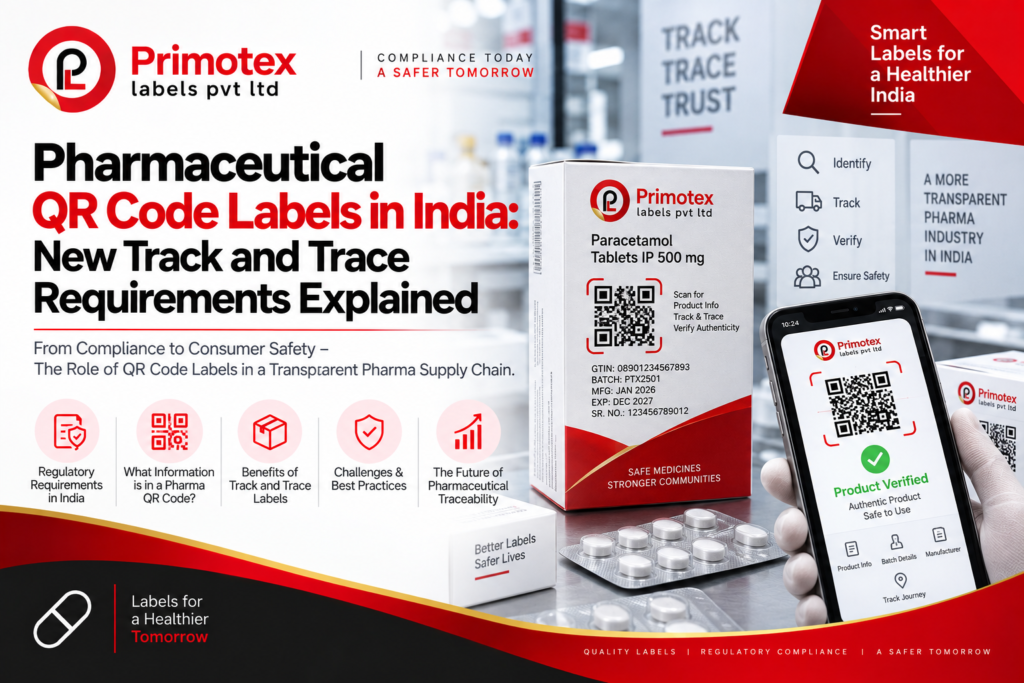
Pharmaceutical QR code labels in India are becoming an important part of modern drug packaging. These labels can connect physical medicine packaging with digital product information, allowing authorized stakeholders to verify and track products across different stages of the supply chain.
Regulatory changes announced in 2026 have expanded the categories of medicines covered by India’s QR code-based track and trace framework. For pharmaceutical companies, this development increases the importance of reliable printing, accurate variable data, and appropriate packaging labels.
Primotex Labels Pvt Ltd provides pharmaceutical labeling solutions focused on printing quality, material selection, and customized packaging requirements for healthcare businesses.
What Are Pharmaceutical QR Code Labels?
Pharmaceutical QR code labels are printed labels containing a scannable Quick Response (QR) code that connects a medicine package to digital product information.
Depending on the implementation, the QR code may provide access to details such as:
- Unique product identification code
- Drug name and brand name
- Manufacturer information
- Batch number
- Manufacturing date
- Expiry date
- Manufacturing licence number
- Other required product information
The specific information stored and the applicable regulatory requirements depend on the relevant notification and product category.
Unlike traditional labels that primarily display printed information, QR-enabled pharmaceutical packaging can support digital authentication and supply chain tracking.
However, printing a QR code alone does not create a complete track and trace system. The code must be correctly generated, linked to reliable data, and verified through an appropriate system.
New Pharmaceutical QR Code Track and Trace Requirements in India
India’s Ministry of Health and Family Welfare announced amendments to the Drugs Rules, 1945, on June 25, 2026. The changes expanded Schedule H2 to include additional categories of medicines under the QR code-based authentication and traceability framework.
The expanded categories include:
- Vaccines
- Antimicrobials
- Narcotic and psychotropic drugs covered under the NDPS Act
- Anti-cancer medicines
The announcement states that manufacturers of covered drug formulations must print or affix a barcode or QR code on the primary packaging label. Where there is insufficient space, the code may be placed on the secondary packaging label.
Implementation Timeline
The government notification provides phased effective dates for the newly included categories:
| Medicine Category | Effective Date |
|---|---|
| Vaccines | July 1, 2027 |
| Narcotic and psychotropic drugs covered under the notification | July 1, 2027 |
| Anti-cancer medicines | July 1, 2027 |
| Antimicrobials | July 1, 2028 |
These dates relate to the expanded requirements announced in June 2026. Pharmaceutical companies should review the official notification and applicable guidance for product-specific obligations.
The QR code framework was previously associated with the top 300 pharmaceutical brands. The expansion increases the relevance of traceability-focused labeling for a wider range of pharmaceutical manufacturers.
What Information Should Pharmaceutical QR Codes Contain?
The 2026 government announcement identifies nine key data elements for each drug product. These elements are intended to support authentication and verification through software applications.
1. Unique Product Identification Code
A unique identification code helps distinguish a specific pharmaceutical product from others. It forms an important part of digital identification and product verification.
2. Drug Name and Brand Name
The QR code framework includes the proper or generic name of the drug and its brand name, helping users and authorized stakeholders identify the product.
3. Manufacturer Details
The name and address of the manufacturer provide information about the company responsible for producing the medicine.
4. Batch and Manufacturing Information
Batch number and manufacturing date support product identification and batch-level tracking throughout the supply chain.
5. Expiry Date and Licence Information
The expiry date and manufacturing licence number are among the data elements identified in the announced framework.
6. Excipients Details
The announcement also includes details of excipients among the required data elements.
Pharmaceutical companies should ensure that their QR code data structure follows the applicable regulatory requirements rather than relying on generic QR code templates.
Why QR Code Labels Matter for Pharmaceutical Traceability
Pharmaceutical packaging passes through multiple stages, including manufacturing, distribution, warehousing, and retail. Each stage creates a need for accurate product identification.
QR code-based systems can support the following activities:
Product Authentication
Digital verification can help authorized stakeholders check product information against a connected database or software application.
Supply Chain Visibility
Traceability systems can help companies follow products through different supply chain stages, depending on the data and systems implemented.
Batch-Level Identification
Batch numbers and manufacturing information can support investigations, inventory processes, and product recall activities.
Counterfeit Risk Management
QR codes can contribute to authentication systems designed to reduce the circulation of counterfeit and substandard medicines. They are not, by themselves, a guarantee that a product is genuine.
The effectiveness of these systems depends on accurate coding, secure data management, scanning performance, and operational controls.
Role of Pharmaceutical QR Code Label Manufacturers
A pharmaceutical label manufacturer plays an important role in the physical production of QR-enabled packaging.
The printing process must support readable codes, appropriate materials, and consistent production quality. A label that cannot be scanned reliably may create operational problems even when the underlying digital system is functioning correctly.
High-Resolution QR Code Printing
QR codes require sufficient print clarity and contrast for reliable scanning. Printing specifications should consider code size, substrate, ink, and the scanning environment.
Variable Data Printing
Pharmaceutical packaging may require different codes for individual products, batches, or production runs. Variable data printing helps manufacturers produce labels with changing information.
Barcode Verification
Barcode and QR code verification can help identify printing defects, missing data, or scanning issues before labels reach the packaging line.
Adhesive and Material Selection
Pharmaceutical packaging may involve bottles, vials, cartons, blister packs, and other surfaces. The material and adhesive should be selected according to the packaging surface, storage conditions, and intended use.
Pharmaceutical Labeling Solutions by Primotex Labels
offers customized pharmaceutical labeling solutions designed around packaging requirements, printing specifications, and material selection.
For pharmaceutical businesses seeking QR code-enabled labels, the manufacturing discussion may include:
- Pharmaceutical QR code labels
- Pharmaceutical barcode label printing
- Variable data printing
- Self-adhesive pharmaceutical labels
- Tamper-evident labeling options
- Waterproof and durable label materials
- Batch and expiry information printing
The right combination depends on the medicine packaging format and the manufacturer’s requirements.
Primotex can be considered as a labeling partner for businesses that need to discuss custom pharmaceutical label production, print specifications, and scalable manufacturing requirements.
Companies should confirm the exact certifications, production capabilities, and compliance documentation relevant to their specific project before placing an order.
How to Choose Pharmaceutical QR Code Labels in India
Selecting the right pharmaceutical label manufacturer involves more than comparing printing prices. Businesses should evaluate several practical factors.
1. Printing Quality
The manufacturer should demonstrate consistent print clarity and the ability to produce scannable QR codes under the required specifications.
2. Material Compatibility
Label materials should suit the packaging surface and storage conditions. Bottles, vials, cartons, and other containers may require different labeling solutions.
3. Production Capacity
Manufacturers handling large pharmaceutical orders need consistent production quality and reliable delivery processes.
4. Quality Control
Businesses should ask about print inspection, barcode verification, adhesive testing, and batch-level quality procedures.
5. Regulatory Coordination
A label printer supports the physical labeling process, but the pharmaceutical manufacturer remains responsible for meeting applicable regulatory obligations. The labeling partner should work from approved artwork, specifications, and regulatory instructions.
Future of Pharmaceutical QR Code Labels in India
The expansion of India’s QR code-based track and trace framework signals continued attention to digital authentication and pharmaceutical supply chain transparency.
As more medicine categories become subject to relevant requirements, pharmaceutical businesses may need to review their packaging workflows, data management systems, and printing processes.
The future of pharmaceutical labeling is likely to involve closer integration between physical packaging and digital identification systems. However, the exact implementation will depend on applicable regulations, industry systems, and company-level requirements.
For pharmaceutical businesses, early coordination between packaging teams, software providers, regulatory professionals, and label manufacturers can help reduce avoidable implementation problems.
Frequently Asked Questions
1. What are pharmaceutical QR code labels in India?
Pharmaceutical QR code labels are packaging labels containing scannable QR codes that can support product authentication and traceability through connected software systems.
2. Which medicines are covered by the new QR code requirements?
The June 2026 expansion includes vaccines, antimicrobials, specified narcotic and psychotropic drugs, and anti-cancer medicines under Schedule H2. The applicable effective dates vary by cat
3. Can QR codes be printed on secondary packaging?
Yes. The announced framework permits placement on secondary packaging where there is inadequate space on the primary packaging label.
Press Information Bureau
4. What information is included in pharmaceutical QR codes?
The announced framework includes product identification, drug names, manufacturer details, batch number, manufacturing and expiry dates, manufacturing licence number, and excipient details.
5. Can Primotex Labels manufacture custom pharmaceutical QR code labels?
Primotex Labels Pvt Ltd offers pharmaceutical labeling solutions. Businesses should contact the company to confirm QR code printing specifications, material availability, order quantities, and project-specific requirements.
Conclusion
Pharmaceutical QR code labels in India are becoming increasingly relevant as the country expands its drug authentication and traceability framework. The June 2026 regulatory announcement introduces additional requirements for selected pharmaceutical categories, with phased implementation beginning in 2027 and 2028.
For pharmaceutical manufacturers, successful implementation involves more than printing a QR code. Accurate data, readable printing, suitable materials, quality control, and regulatory coordination all contribute to reliable packaging.
Primotex Labels Pvt Ltd can support businesses exploring customized pharmaceutical labeling solutions. By discussing packaging requirements and printing specifications in advance, pharmaceutical companies can plan labeling workflows that align with their operational and compliance needs.